To expand new fields into society, it is not enough to simply present research outcomes. What is essential is a process of articulating and sharing their value while engaging a diverse range of people. By making still-emerging domains visible and gaining social recognition and legitimacy, they can grow into new movements.
In this article, we introduce the HAPTIC DESIGN PROJECT, an award that opened up the potential of a new field to society by integrating research and design perspectives around the theme of “haptics.”
This article has been re-edited based on the case study “HAPTIC DESIGN PROJECT” originally published by Loftwork Inc.
Project Highlights
The HAPTIC DESIGN AWARD 2017 focused on “HAPTIC DESIGN,” an emerging design field that connects the self and the world through the sense of touch.
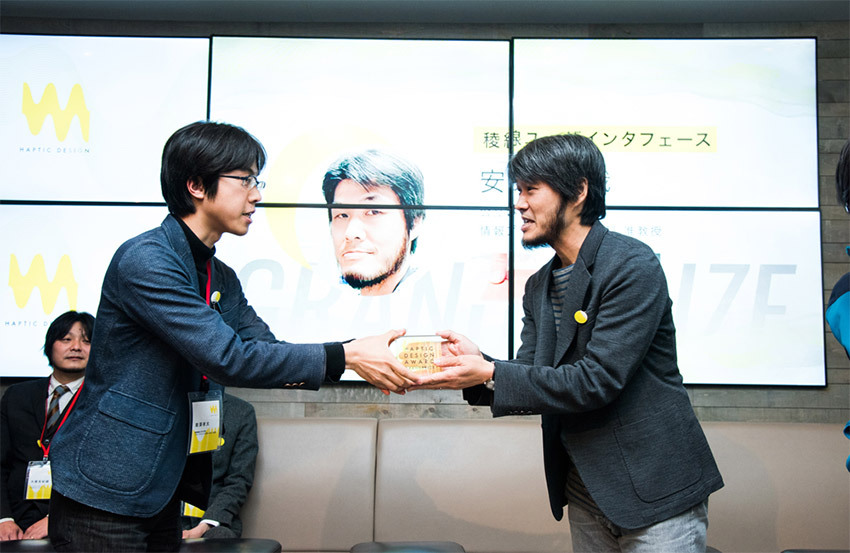
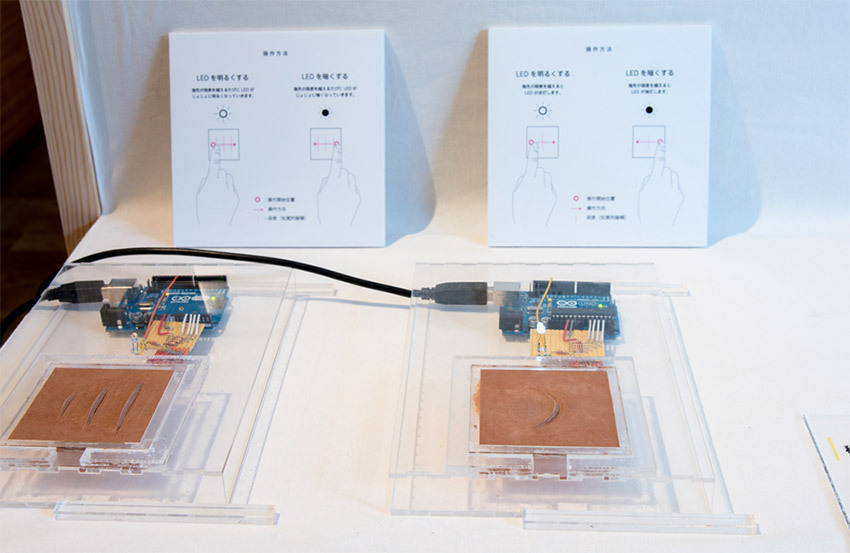
In 2017, the award received 116 submissions from 20 countries. Here, we present a selection of outstanding works—including the Grand Prix winner and other notable projects—featuring original outputs that directly engage bodily sensation.
Outline
Turning Haptics into a New Design Movement
As part of the innovation-driven R&D support program ACCEL run by the Japan Science and Technology Agency (JST), the JST ACCEL Embodied Media Project (Principal Investigator: Susumu Tachi, Professor Emeritus at the University of Tokyo) launched the HAPTIC DESIGN PROJECT to promote the industrial application of the haptics field.
Loftwork supported this initiative from its inception. In addition to existing industry, academia, and engineering communities, the project actively engaged designers, creators, and other new players. Through initiatives such as awards and community-building efforts to foster a new generation of “haptic designers,” the project worked to elevate HAPTIC DESIGN as a movement and advance its social implementation.
Project Overview
Scope of Support
Research: Defining project goals through new insights
Planning: Developing concrete initiatives and creating a three-year forward-looking scenario
Execution: Implementing the scenario and combining multiple initiatives to build a movement
Approach
Reframing: Rediscovering the Value of Haptics
Based on existing research and outputs, the project re-examined the potential of this emerging field and uncovered previously unrecognized aspects of haptics, leading to the rediscovery of its new value.
Communication Design: Designing Communication Centered on Web Media
The concept of HAPTIC DESIGN was refined and a visual identity (VI) was defined, then deployed across a dedicated website. Through a media-driven website, haptics were reinterpreted using familiar themes such as food, fashion, and entertainment.
Award: Designing an Award to Generate a Movement
Through an award centered on HAPTIC DESIGN, the project aimed to discover emerging haptic designers and create a mechanism to attract broader public attention. Alongside promotional activities such as events, the initiative sought to significantly expand participation in the haptics field.
Exhibition: Showcasing Outcomes and Creating Touchpoints
Award-winning works were exhibited at FabCafe Tokyo and FabCafe MTRL, presenting the project’s成果 and creating tangible touchpoints for the general public.
Project Team
- Organizer: JST ACCEL Embodied Media Project
- Collaborators: Grant-in-Aid for Scientific Research on Innovative Areas “Multi-Sensory Texture Perception,” NTT Communication Science Laboratories, Keio University Graduate School of Media Design
- Operations Support: Loftwork Inc.
- Producer: Takashi Shirae
- Project Manager: Taeko Watanabe
- Members: Ryosuke Hara / Tomoko Sekiguchi / Satoko Kitajima / Kazuya Obara / Kaori Onomura
Outputs
Web Media
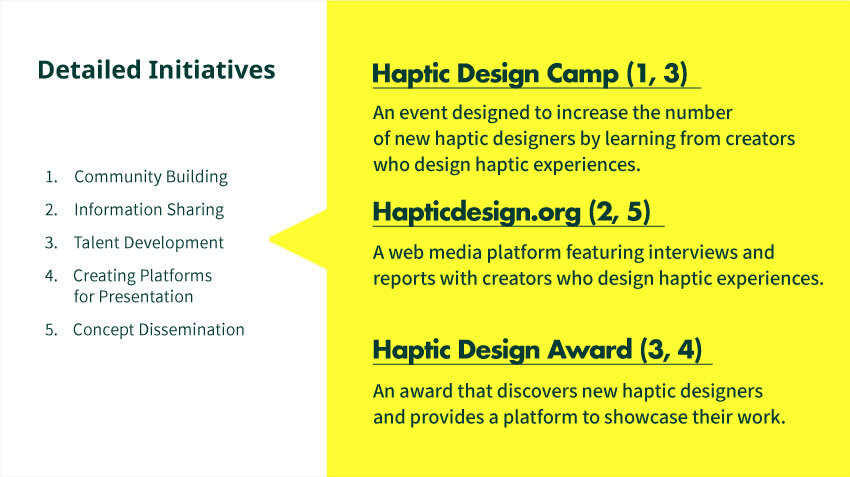
The project launched Hapticdesign.org, a web media platform featuring interviews and reports with creators who design haptic experiences.
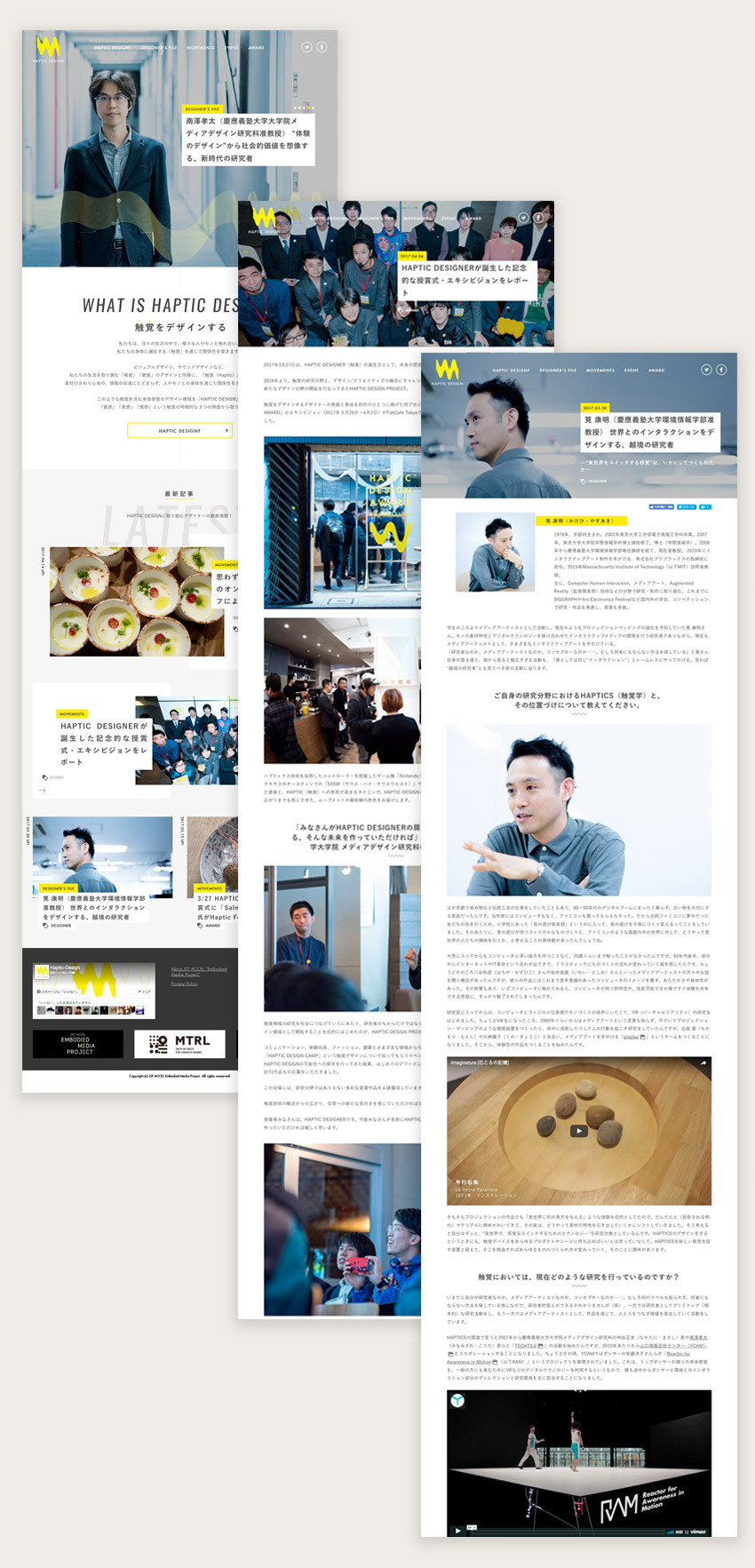
HAPTIC DESIGN Website
Hosting the HAPTIC DESIGN AWARD
To discover new HAPTIC DESIGNERS and connect their activities to social implementation, AWRD hosted the HAPTIC DESIGN AWARD 2017 as a platform for open entry.
As Japan’s first award dedicated to the theme of haptics, it received 116 ideas during an approximately three-month submission period.
Related Links
HAPTIC DESIGN AWARD – Results Announcement
Process
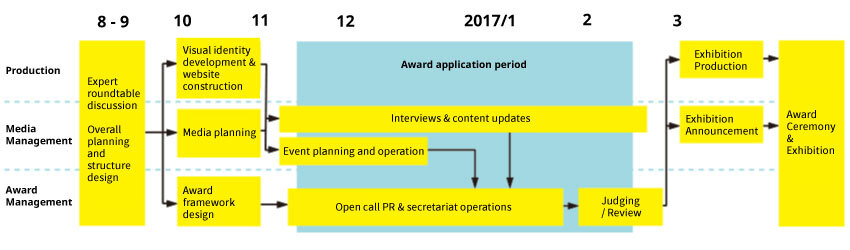
Research: Defining Project Goals Through New Insights
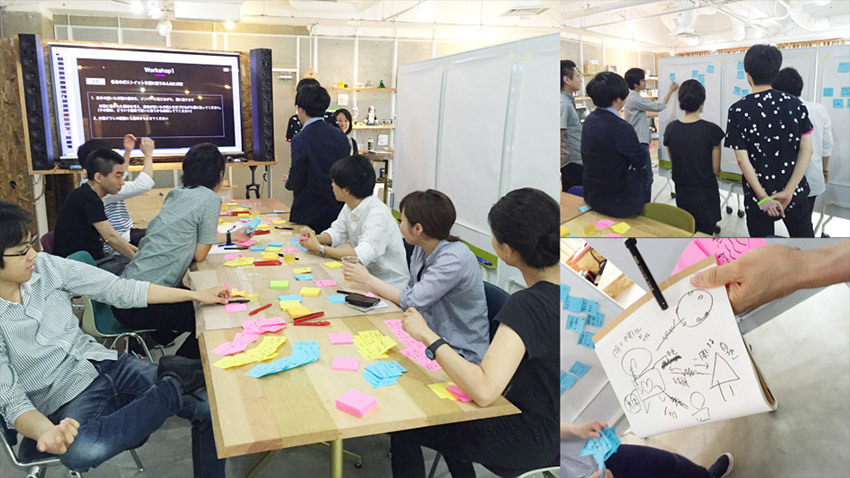
As the kickoff to the project, all team members worked together to visualize the world they aimed to realize, the future they aspired to, and the overall scope of the initiative. In addition, a two-day workshop was held in which participants revisited and organized their own formative experiences of “touch,” sharing them with one another and collectively exploring their individual and shared perceptions of haptics.
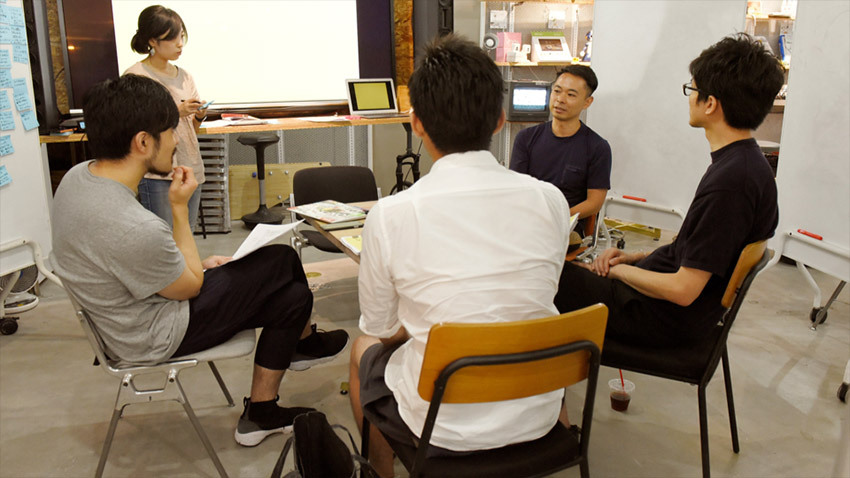
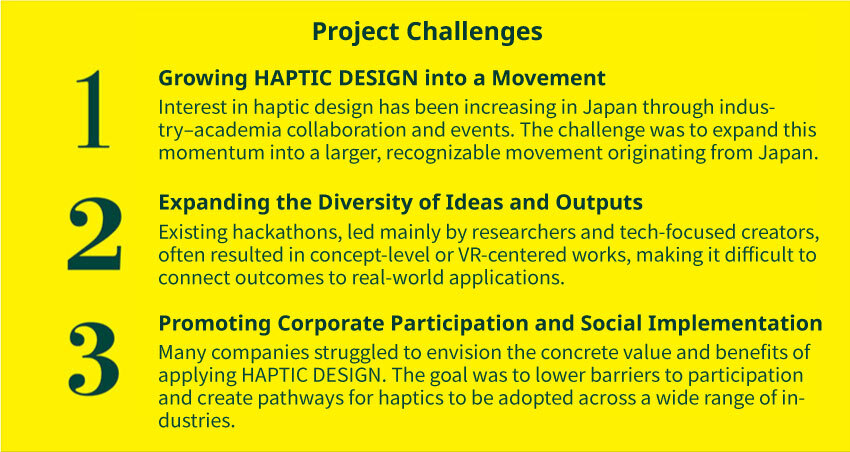
The team also conducted interviews with external experts from a wide range of fields to research the future potential of haptics. Through this process, key challenges were identified and organized for each major stakeholder group: companies, developers, and creators.
Planning: Developing Concrete Initiatives and a Three-Year Scenario
As a first step in addressing the challenges, the project clarified goals for each stakeholder group. Possible actions were then mapped out and structured into a scenario extending three years into the future.
Execution: Creating Resonant Content and Building a Movement
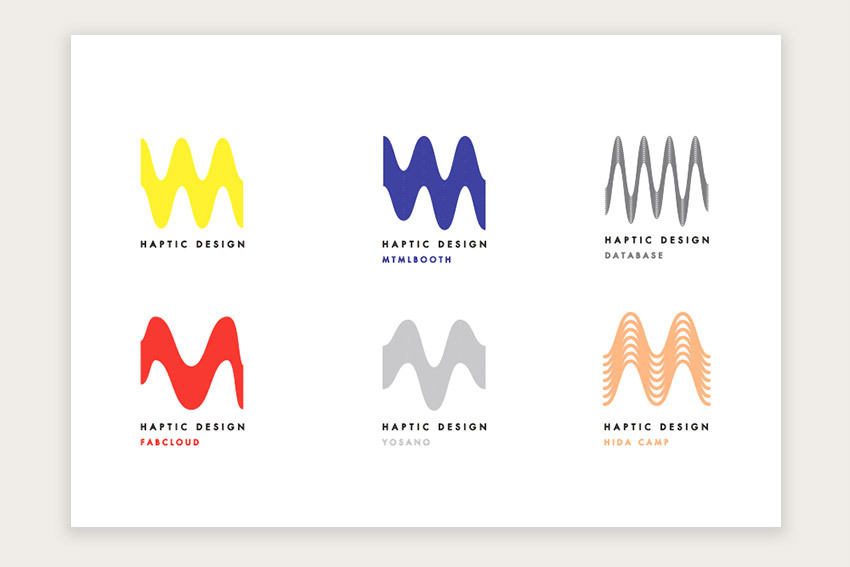
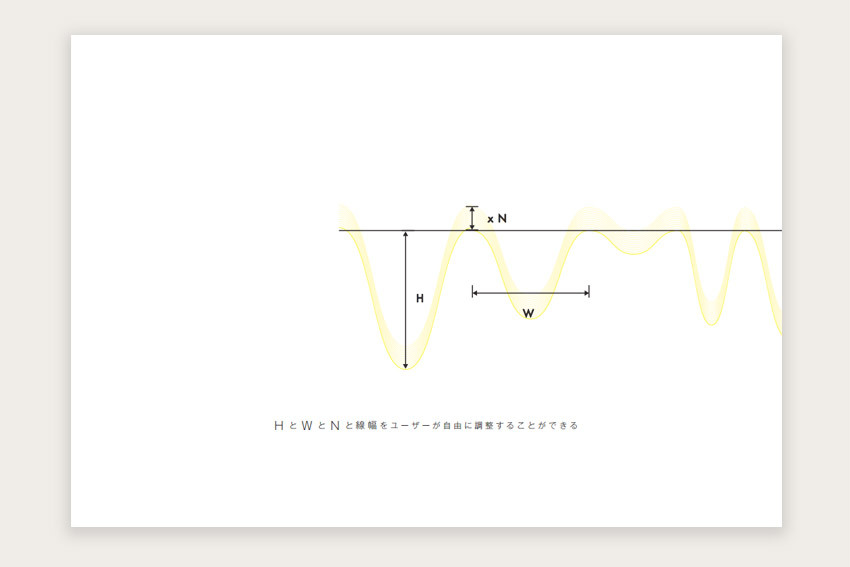
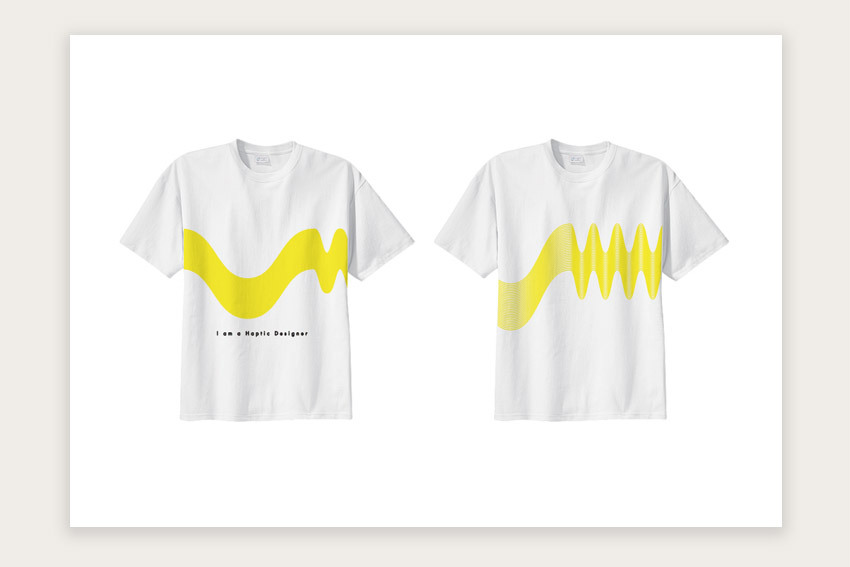
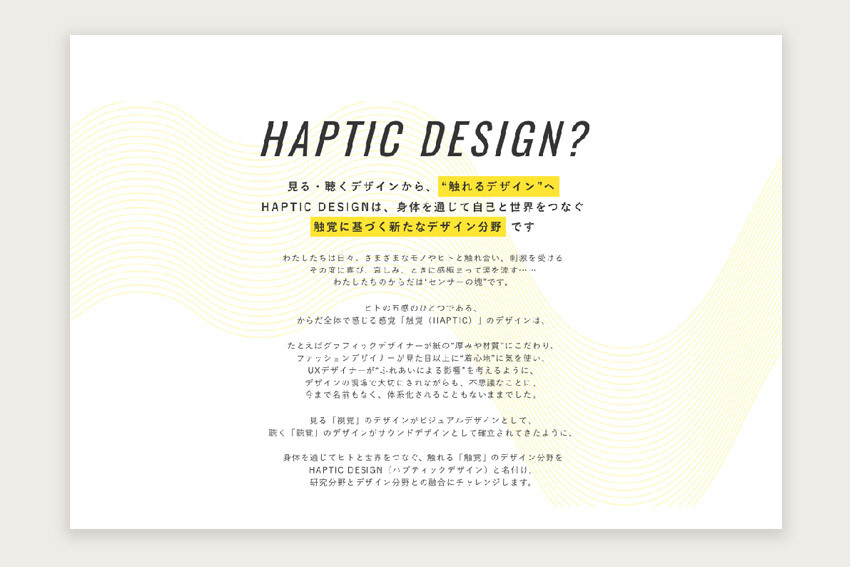
The project thoroughly explored and articulated what HAPTIC DESIGN is, giving clear form to the concept. A visual identity (VI) expressing its worldview was developed, along with carefully defined language to communicate its meaning.
The project planned and hosted HAPTIC DESIGN CAMP, an event aimed at building a community that learns from creators who design haptic experiences and nurtures a new generation of haptic designers.
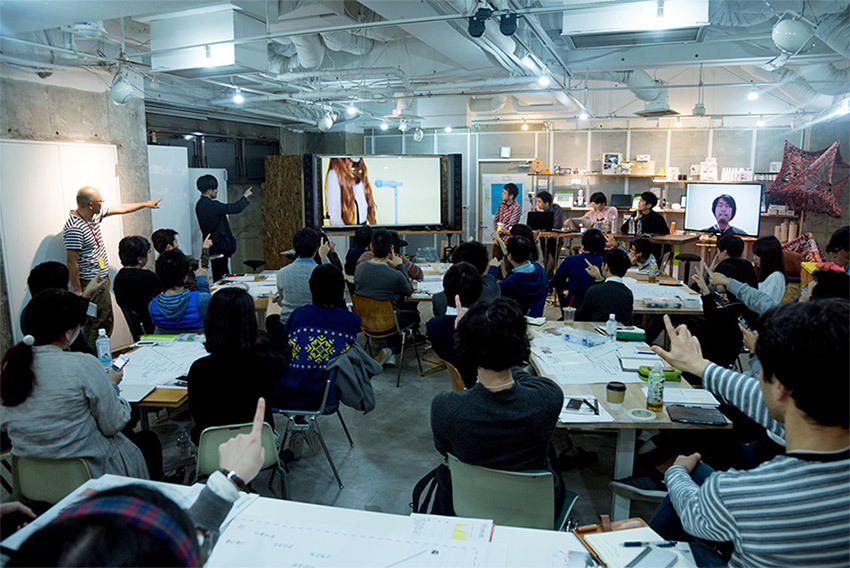
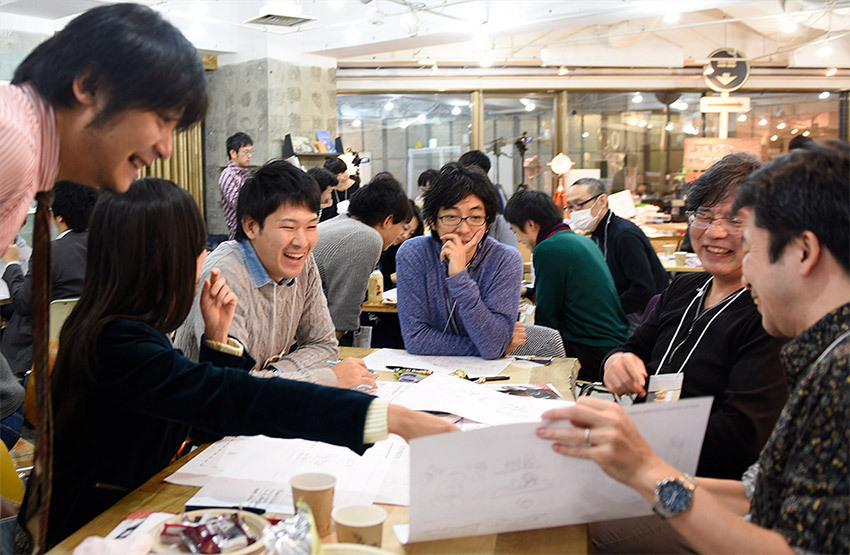
Participants learned about the latest approaches to haptic design from front-runners in the field and then used a variety of readily available tactile materials to prototype new ideas.
Integrating Initiatives to Maximize Impact
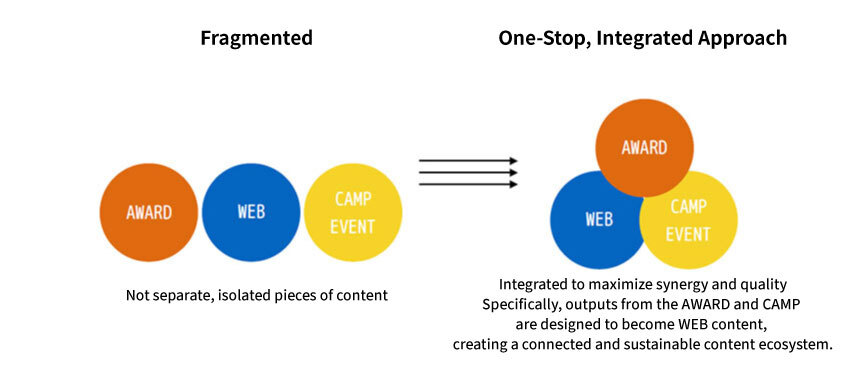
Because the initiatives needed to be implemented within a short timeframe, strategies were designed to achieve the project’s goals both effectively and efficiently. Each initiative was closely coordinated and integrated, aiming to generate strong synergy effects.
Related projects
Like the HAPTIC DESIGN PROJECT featured here, AWRD provides platforms for discovering the potential of emerging fields and expanding value through co-creation between companies and research institutions. We invite you to explore similar initiatives and learn more about how AWRD can be utilized.
View Other Co-Creation & Design Project Examples
Browse the full list of AWRD case studiesWays to Leverage Co-Creation and Design with AWRD
Learn more about AWRD services and how to use them
AWRD is an open call platform for co-creation where companies, local governments, and creators collaborate on diverse themes.
By inviting projects and talent from around the world, it enables initiatives in business development, community co-creation, and startup support through open innovation.
From project design to operational support, AWRD accompanies initiatives every step of the way, fostering co-creation that opens up value to society.