NEWVIEW AWARDS 2024 Award-Winning Works
The project and community NEWVIEW, which pioneers new creative expressions and experiences in three-dimensional space, has launched the global creative award "NEWVIEW AWARDS 2024" to expand the possibilities of spatial computing.
Since 2018, the NEWVIEW AWARDS has been held five times, discovering and nurturing next-generation artists and creators leading the XR (VR/AR/MR) field. In this sixth edition, the focus is on reframing and deconstructing information, space, and experiences in the real world through spatial computing, weaving new perceptions and evolving our narratives.
This year, the competition featured two categories: the Spatial Computing category, which sought content for Apple Vision Pro, and the Site-specific AR category, which invited AR works that leverage location-based experiences.
During the application period from August 21, 2024, to October 16, 2024, a total of 95 works from 10 countries were submitted (52 in Spatial Computing and 43 in AR). After a rigorous screening process by the secretariat, 19 works were selected as finalists (11 in Spatial Computing and 8 in AR).
The award-winning works are announced on this page.
Details of the award-winning entries and the finalists who narrowly missed out can be viewed on the NEWVIEW AWARDS 2024 website.
GOLD Prize
Spatial Computing Category
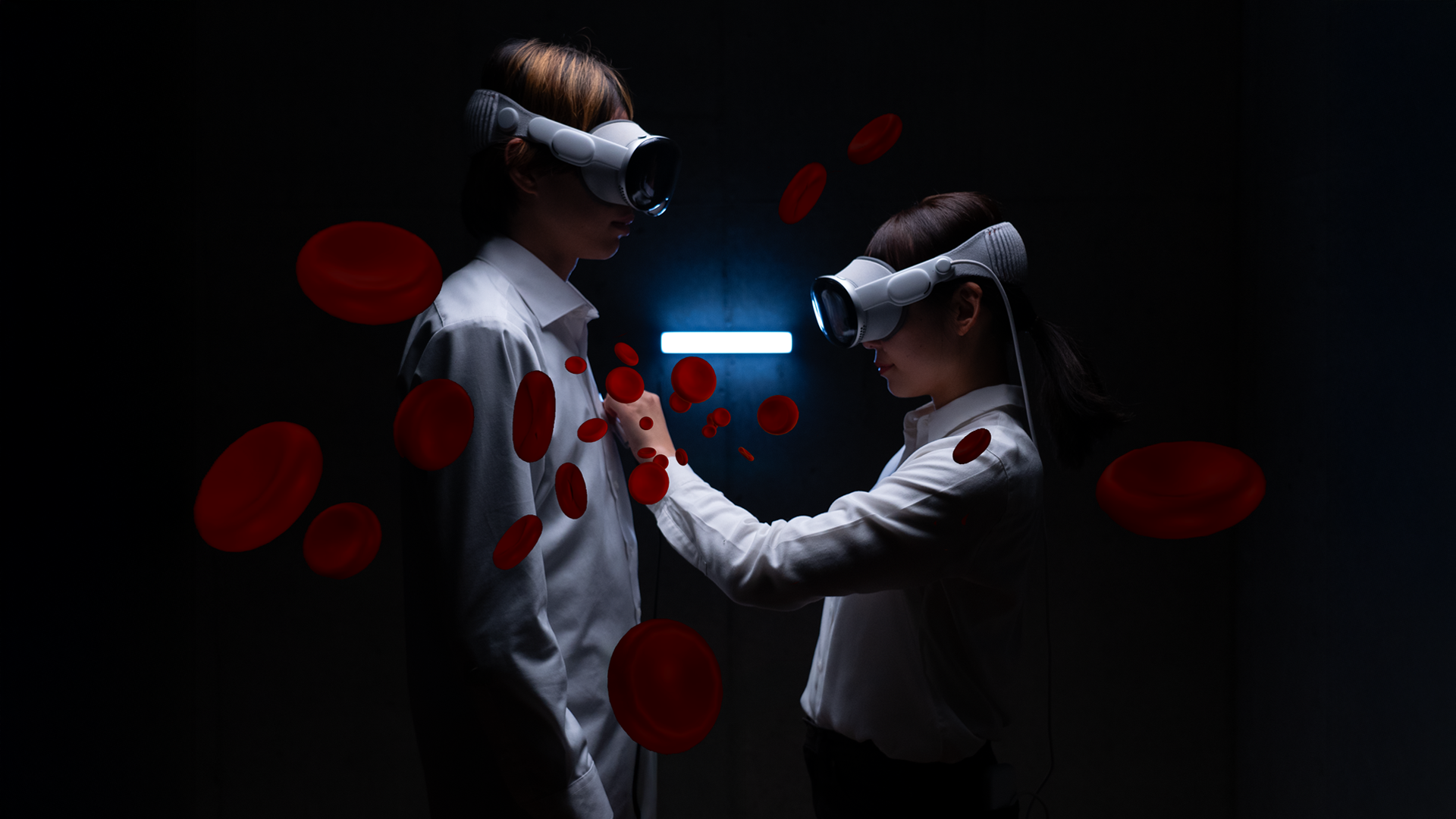
RESORACLE ─ Heartbeat Verification System ─
Megumu Hanayama
JUDGES COMMENT:Naohiro Ukawa
House music typically operates around 120 BPM, a tempo derived from the threshold of tachycardia—a rapid heartbeat. In other words, the rhythm of the dance floor pulses in resonance with the human heartbeat.
The title RESORACLE is a coined term combining Resonance (meaning “harmonic vibration” or “evocation”) and Oracle (meaning “prophecy” or “divine revelation”). This metaphysical work explores a profoundly essential form of data mining in the era of massive data flow.
The heartbeat—a crystallization of existence—is emerging, alongside brainwaves, as a new form of bodily signature in an age where personal data is heavily protected. This piece encapsulates both the concerns and possibilities of big data in 2024, bringing them into the public consciousness.
JUDGES COMMENT:KEIKEN

「RESORACLE ─ Heartbeat Verification System ─」 is a fascinating exploration of connection through technology, centering on the heart—one of the most powerful and deeply human aspects of our existence. The heart is a powerful bridge between the physical and emotional realms, not only sustaining life but also regulating emotions, influencing cognition, and fostering deep human connection through its biological, energetic, and symbolic significance.
In a world where digital spaces are becoming more entwined with daily life, using heartbeats as a marker of presence by visualising it as pulsating “RESONITE” particles feels both poetic and profound making digital existence feel more tangible. This piece offers a unique perspective on embodied presence in virtual spaces, grounding technology in something real, biological, and human. It reminds us that even in virtual spaces, our existence is not just seen but felt.
I hope to see more heart-centered approaches to technology & digital spaces!
JUDGES COMMENT:Saeborg

Our earliest memory might be the sound of our mother’s heartbeat.
That deep, rhythmic pulse—like the hum of an engine—becomes undeniable when we bury our faces into the fur of a cat, feeling the presence of another living being.
The heart, an instrument in its own right, is both a primal experience and an essential organ. By turning its sound into a tool for communication, we affirm the rhythm of life itself.
Beyond simply recognizing the sounds emitted by the body, RESORACLE questions the heartbeat as an existential marker. It’s not just about defining life—it’s about contemplating the pulse of existence itself.
JUDGES COMMENT:David OReilly

RESORACLE is a thoughtful exploration of existence in digital spaces, responding to the evolution of technology and the shifting nature of human presence online. By using heartbeats—a very human signal—this project offers a poetic and personal way to reaffirm physical presence in a world where the boundaries between digital and real continue to blur. The attention to detail in both the software and presentation enhances the work, making it a compelling and well-executed piece.
JUDGES COMMENT:Gerfried Stocker
The work Resoracle is an outstanding contribution to this award by delving into the social possibilities of XR. It also raises essential questions about how our self-image and self-experience will transform in the face of the increasingly immersive presence of interactive extended realities. This is not only an exciting topic in terms of technological development but also a fundamental subject of artistic contemplation and introspection.
By doing so, the project reflects on the entire spectrum of applications for spatial computing and the many directions in which this emerging technology will evolve - both as a tool and stage for artistic work and as an extension of our communicative possibilities. Thus, this project is not only an almost inevitable award winner but also a compelling example of what artistic research can achieve.
Site-specific AR Category
Immersive Novel
KamiEna
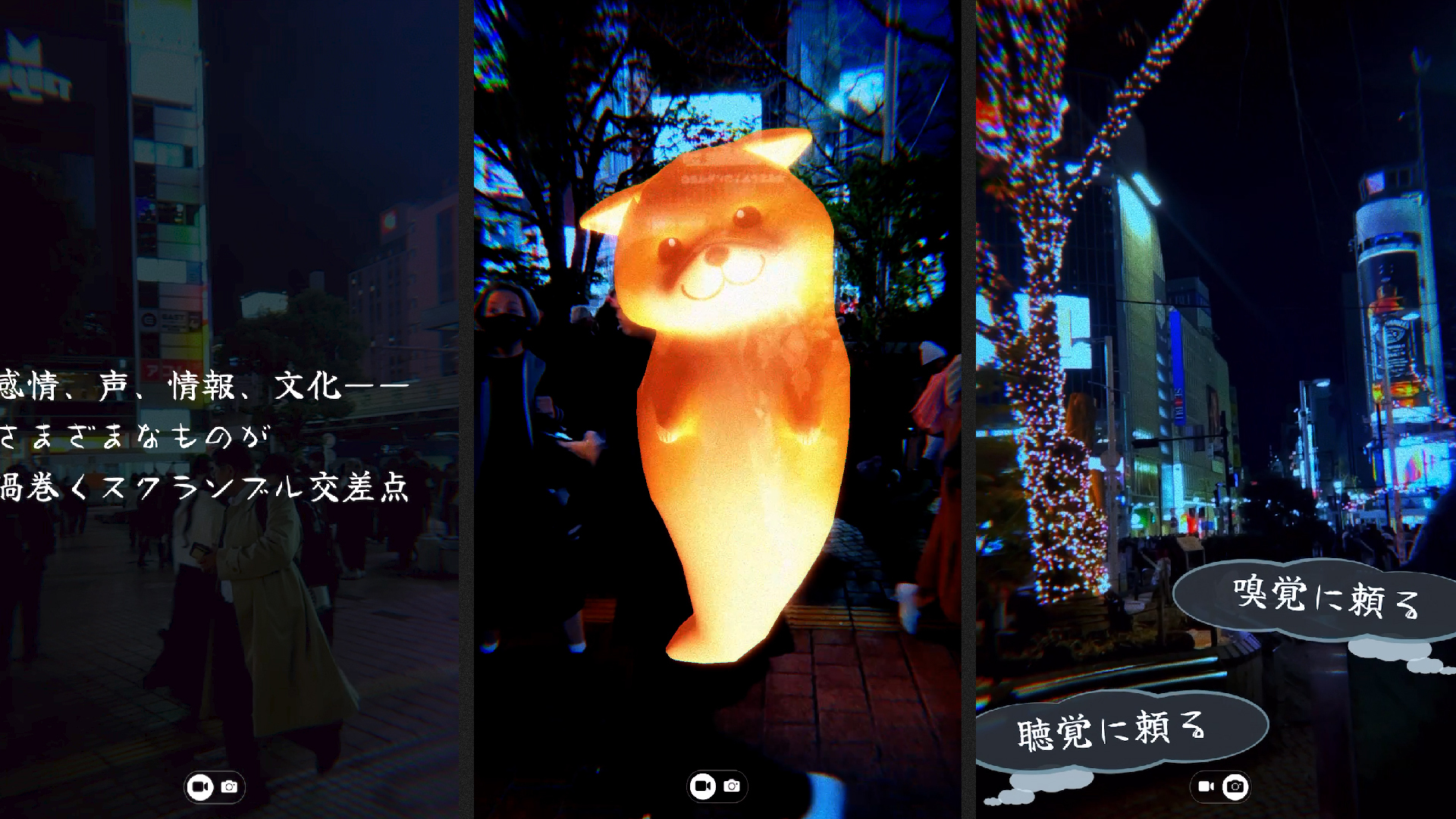
JUDGES COMMENT:Naohiro Ukawa
Like immersive, site-specific has functioned as a magic word of the 2020s. Considering the uniqueness of such places, the area in front of Hachiko in Shibuya can be seen as the most universal public space, steeped in history and tradition. This work transforms the stories embedded in the environment into an experiential novel.
A dialogue with Hachiko’s spirit, set just beyond the Shibuya Scramble Crossing, transcends augmented reality—it infiltrates the human psyche, shifting form into an interactive spiritual invocation. Through the Immersive Novel, much like how itako or miko act as mediums for spirits, one experiences the nested expansion of the body as a meta-media that aligns itself with the city as a medium.
JUDGES COMMENT:Saeborg
This nameless dog is the bound spirit of Hachiko—a lingering thought, a ghost. The idea of introducing a spirit tethered to a specific place perfectly embodies the concept of site-specificity.
Encountering an ordinarily invisible ghost through technology is a unique and compelling approach. The act of Hachi finding peace and passing on after interacting with the user is deeply interactive, making the presence of the site itself an active force—an experience that cannot be replicated in a conventional novel. And strangely, in the process, one's own heart feels cleansed.
Thinking about it this way, waiting at the Hachiko statue takes on a deeply emotional significance—the anticipation of finally meeting someone becomes a profoundly special experience.
In a world centered around human perspectives, this work challenges that norm by expanding awareness first to animals, and then even further to the unseen presence of spirits. It is a bold exploration of non-human perspectives and the invisible layers of existence.
JUDGES COMMENT:Lu Yang
This piece is filled with love and emotion, and its presentation using AR is very fitting. Through augmented reality, it's as if people are given the eyes to see the spiritual world, witnessing the devoted Akita dog Hachikō floating at the very spot where he famously waited for his owner each day, which is profoundly moving. The content of this work and its technical execution are excellently integrated.
JUDGES COMMENT:David OReilly
Immersive Novel offers a unique, site-specific experience that blends storytelling with AR technology. By guiding players through the narrative using a popular character, it creates a connection between the player, the environment, and the story. The interplay between the player’s movements and the unfolding narrative is seamless, turning the experience into a living, memorable interaction with the location. This project’s charm lies in its ability to establish a new niche for AR/VR storytelling, using character-driven engagement to leave a lasting impression. It’s a thoughtful and creative approach to immersive storytelling.
JUDGES COMMENT:Gerfried Stocker
“Immersive Novel” is an XR project that seamlessly transfers all the qualities of classic storytelling into the world of interactive virtual experiences. What is particularly impressive is the way in which location, narrative, and user interaction are inseparably intertwined. This results not only in a work of great poetic and artistic quality but also in a compelling example of artistic and technological exploration with strong exemplary value. A winning project with immense inspirational potential.
JUDGES COMMENT:KEIKEN
「Immersive Novel 」is a charming and thoughtful use of site-specific AR, set in Shibuya Station and built around the Hachiko dog ghost legend. AR is especially fitting for ghost stories—it acts as a lens, revealing things we can’t see with our own eyes. The way the ghost appears through AR mirrors how spirits exist just beyond our perception, making the experience feel even more immersive. A beautiful example of how AR can bring folklore & storytelling to life.
SPECIAL PRIZE
TOKYU Corporation PRIZE
Karma
Shinya Hasebe
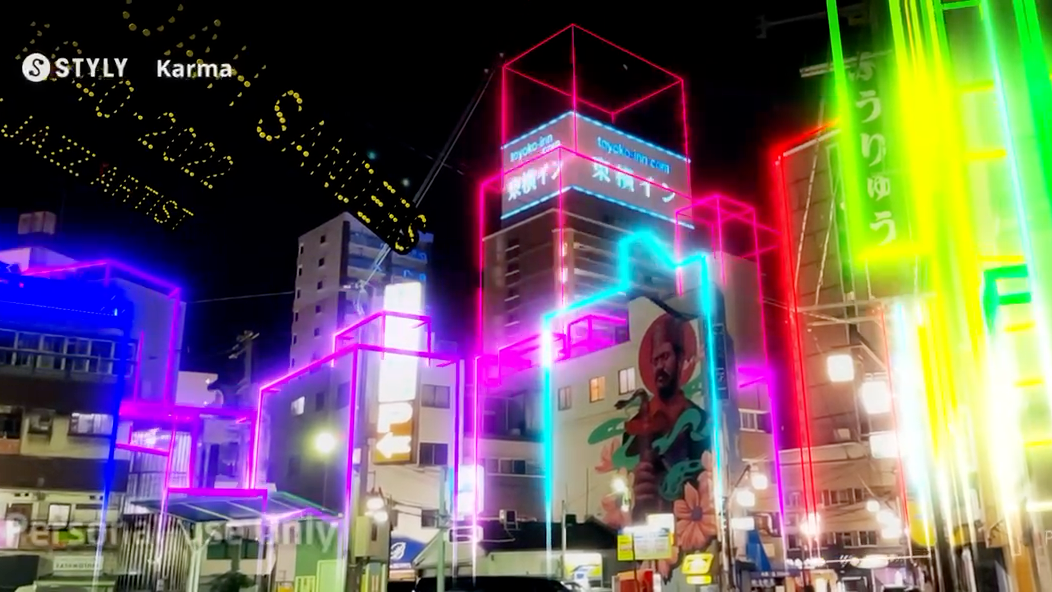
JUDGES COMMENT:David OReilly
I'm delighted to present this jury prize to a work that masterfully amplifies the essence of its site. This piece harmonizes the nostalgia of Jusan’s disappearing neon lights with synchronized animations that feel deeply attuned to the environment. The animation breathes life into the murals, bridging past and present, while the thoughtfully chosen music elevates the experience greatly. The homage to Pharoah Sanders resonates profoundly, creating a tapestry of sound and imagery that captures the soul of jazz and the spirit of a community in transition. This is a poignant and beautifully executed piece, a true celebration of place, memory, and hope.
JUDGES COMMENT:Akihiro Watanabe( TOKYU Corporation PRIZE Jury)

There were many wonderful works, making the judging process very challenging. However, as TOKYU Corporation—a company engaged in community development—I chose Shinya Hasebe’s “Karma” from the perspective of “being the element that most enhances the value of that space.” I was deeply moved by the beauty of this series of projects, in which a dystopian space born out of the COVID-19 pandemic is transformed into a utopia through the power of creators and artists. (Incidentally, “Karma” inspired me to delve further into research on the city of Jūsan, the Yodobashi Project, and Pharaoh Sanders.)
This work involved a collaboration with physical wall art, and it reaffirmed my realization that urban spaces are full of mediators that can facilitate creative collaborations. I look forward to many more wonderful collaborations in the future.
PARCO PRIZE
Bloom in Motion
JACKSON kaki
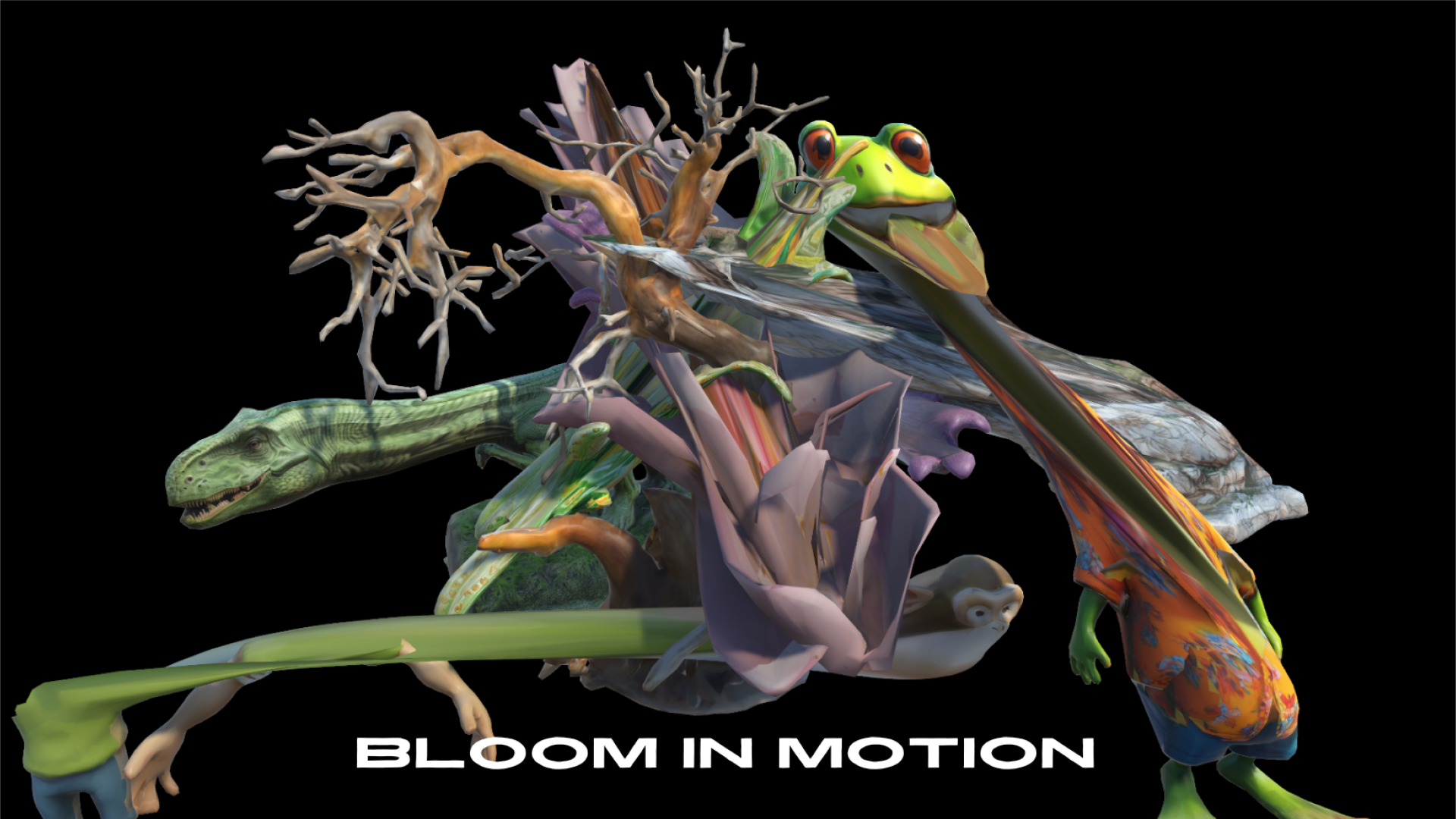
JUDGES COMMENT:Saeborg
Actually interacting with it felt like a cyber ikebana—playful and highly enjoyable. The unique sensation of manipulating a material that stretches and contracts like gum was particularly captivating.
There’s a comforting sense of security in playing within a tree-centered, enclosed space, almost as if the limitations of the environment were cleverly embraced. The inclusion of not just flowers, but also dinosaurs and various creatures, adds to the experience—despite the small scale, it feels like a space where an entirely new world can be created.
In that sense, rather than evoking Hanasaka Jiisan, it felt more like a miniature sandbox inspired by the World Tree of Norse mythology—a contained yet expansive playground of creation.
JUDGES COMMENT:Chihiro Tezuka( PARCO PRIZE JURY)

This work embodies the unique interactivity of digital art, where the act of manipulation becomes an integral part of the experience. With the advent of Apple Vision Pro, the displayed objects attain an unprecedented sense of reality—one that makes them feel truly present. The addition of hand tracking further enhances this by allowing users to pinch and interact with virtual elements with tangible feedback.
By merging cutting-edge technology with artistic expression, this piece demonstrates a bold exploration of next-generation reality—a work that could only be born now, in this early stage of the technology’s evolution.
Moreover, its approach suggests the potential for a new form of artistic expression, as the act of pinching in a virtual space influences not only visuals but also music, creating a multisensory experience.
ASAHI BREWERIES PRIZE
VEGA: Reach your Stars!
grace park
JUDGES COMMENT:Mizuho Kajiura(ASAHI BREWERIES PRIZE JURY)

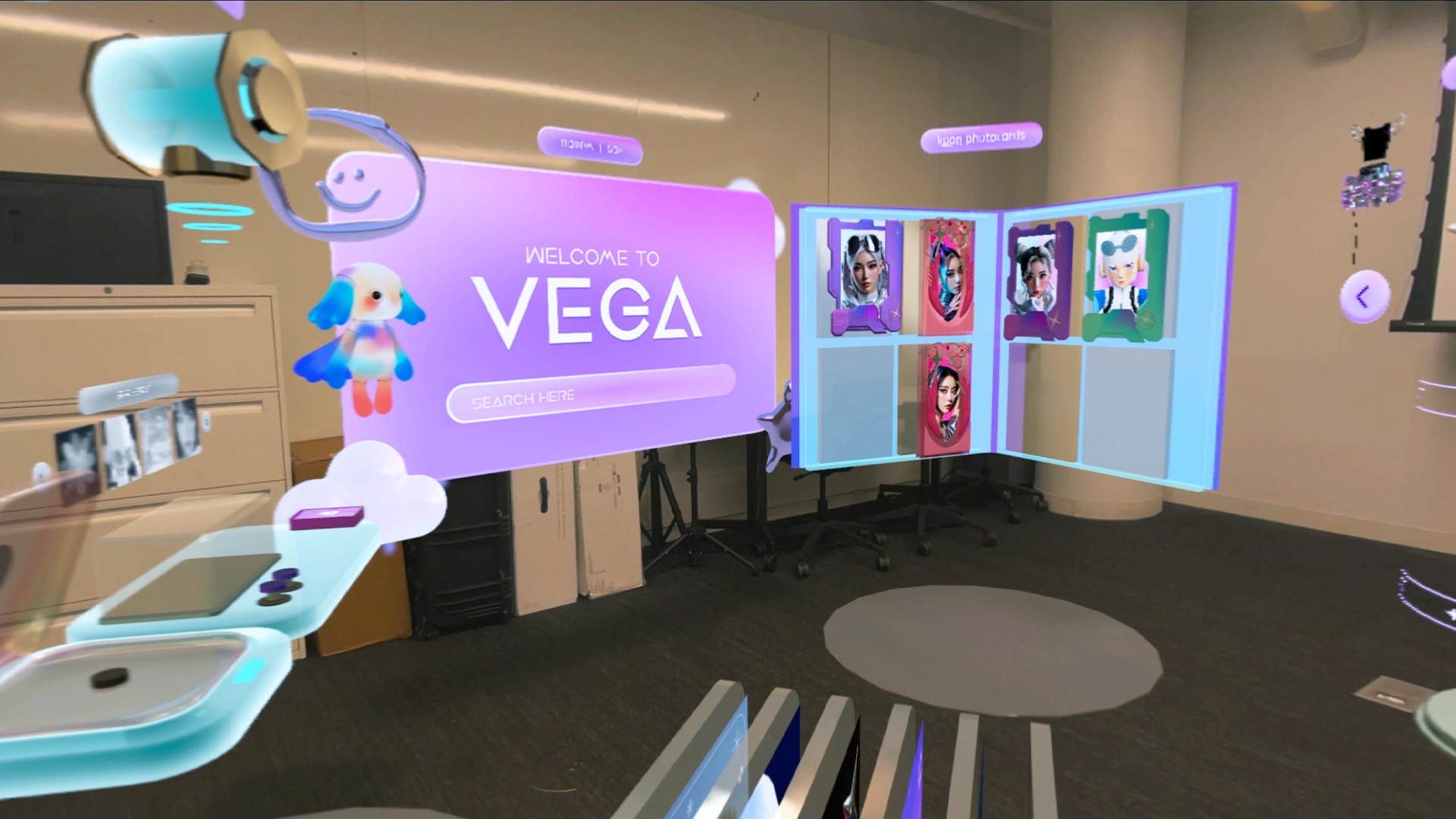
"VEGA" was an ambitious endeavor aimed at redefining the future of the internet. Instead of relying on traditional flat screens, the interaction with 3D information provided a novel experience that enriched the meaning of each item and raised our expectations for the future of XR.
Each 3D gadget was crafted with care, clearly reflecting the creator's affection for the K-POP girl group and their desire for users to share that sentiment.
The experience of exploring information—where the boundaries between the digital and physical realms are transcended through the visualization of a search engine offered by VEGA—strongly resonated with Asahi Breweries’ vision of “providing every customer with the best tomorrow.”
We selected the Asahi Breweries Prize in the hope that this innovative approach will further extend into various fields and inspire new collaborations in the future.
AWE PRIZE
RESORACLE ─ Heartbeat Verification System ─
Megumu Hanayama
JUDGES COMMENT:AWE(AWE PRIZE JURY)

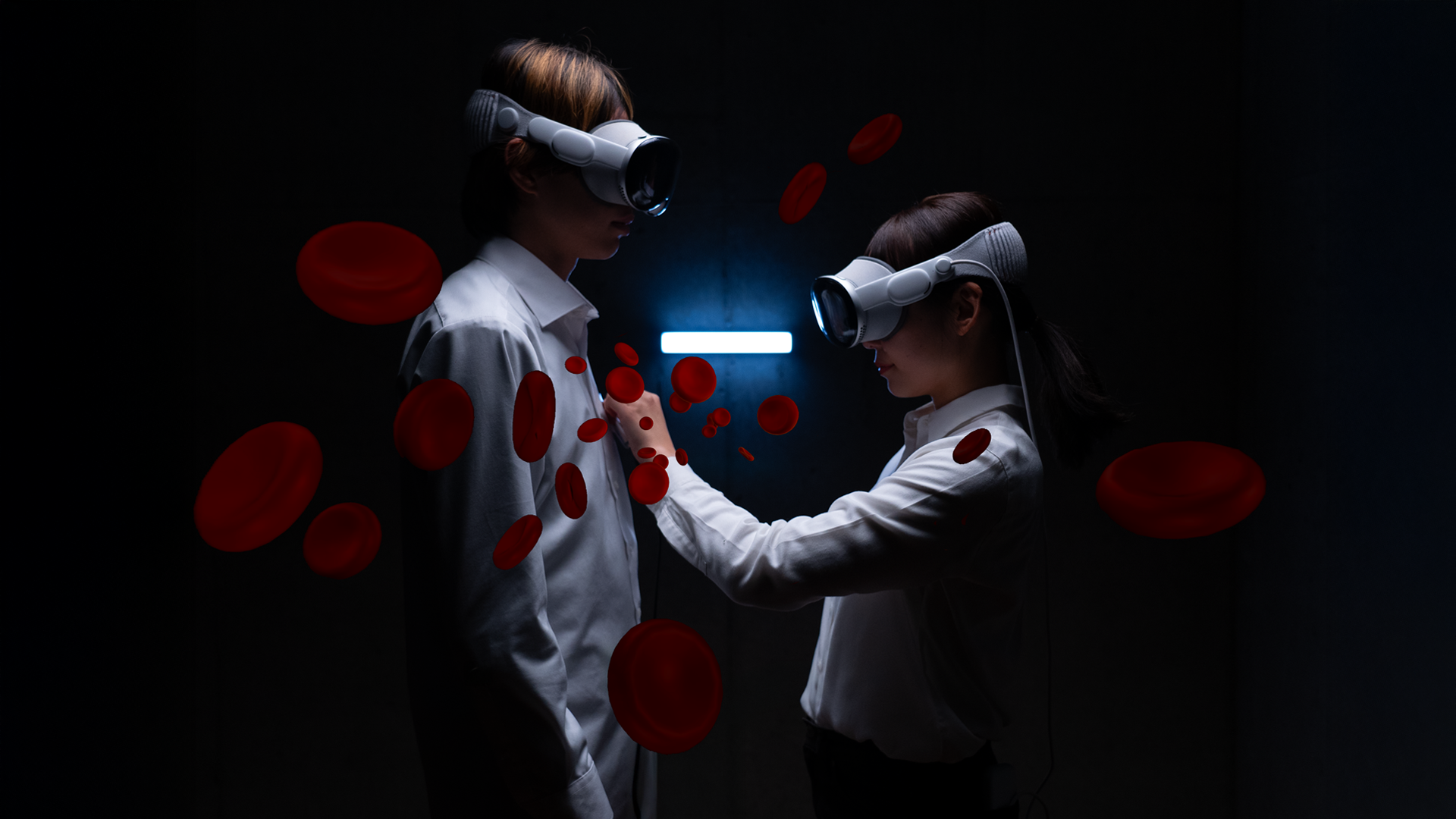
This is a novel idea that puts the human being at the center of a virtual experience. With the rise of AI, trust in the fact that users are interacting with another 'real' human being will almost certainly become more of an important question in immersive experiences.
Whilst virtual and mixed reality technology provide an incredible ability to connect people through digital presence, AI-powered avatars and virtual humans are making it harder for users to know when an interaction is with another real human being. RESORACLE offers a solution that combines cutting edge XR technology with a fundamental part of human biology - our heartbeats.
It also raises questions about how we will verify our humanity in the not-so-distant future when existing alongside superintelligent AI beings, which now almost seem like an inevitability as technology rapidly advances.
SPECIAL RECOMMENDATION PRIZE
Self-Homicide
Katsuki Nogami
JUDGES COMMENT:Naohiro Ukawa
I have been following Katsuki Nogami's works chronologically for nearly a decade, ever since the time he co-created the music video EYE for group_inou with Baku Hashimoto, which won the New Face Award at the 2015 Japan Media Arts Festival. And last year, with Body Memory, I had the opportunity to mentor his project for six months, during which I was deeply moved by its delicate, almost literary sensitivity and innocence. Throughout his career, his works have maintained a consistent artistic identity.
Indeed, there has always been a social critique surrounding avatars in his works, yet at the same time, a contradictory self-loathing coexists within them. It is precisely this naivety that allows his work to transcend the categories of media art and cross-reality, resisting being subsumed by technology itself, and instead, embodying the intensity of pure art.
His latest work, Self-Homicide, continues along this thematic trajectory. The motivation behind this piece lies in the conceptual “homicide” that takes place within the virtual and semi-real spaces of online games and social media, occurring day and night. At the same time, it presents a critique of Japan, the developed country with the highest suicide rate. Given this, the theme of “death” in this work is undoubtedly sensitive. However, it is not an expression that encourages or incites suicide or self-harm. On the contrary, one could even imagine that someone might reconsider suicide after experiencing the virtual Self-Homicide within this piece. The work presents its message with such clarity that it cannot be ignored.
Speaking of which, The Complete Manual of Suicide, a book by Tsutsumi Tsutomu that became a million-seller in the 1990s and caused a social phenomenon, paradoxically explained how to survive in this world by keeping the option of suicide as a last resort. At the time, copies of the book were found at numerous suicide sites, sparking widespread controversy. However, in today's internet age, cyberspace is filled with book reviews from people who continue living with this book as their emotional safety net. In other words, it is a double-edged sword.
And precisely because Self-Homicide is a double-edged sword, a warning appears on its overview video on YouTube. This is to be expected. Interpretations vary widely, but the subject of death is inherently present. Simply put, there is concern that the work might connect with viewers' suicidal ideation (intermittent desires for death) or impulses toward suicide. As a result, the national mental health helpline number is automatically linked and displayed on the overview video. This happens because the word "suicide" is included in the title. On YouTube, when you search for "suicide," a message appears saying, You are not alone, and only after clicking Show Results Anyway does the video finally appear. Self-Homicide is no exception—it is undoubtedly a work that must be approached with great delicacy when shared with others.
In the modern age, any work related to such themes must pass through numerous explanations and security measures before granting access, ensuring that the experience remains a conscious choice. Even the experience of Self-Homicide, which does not advocate for suicide but rather urges us to reconsider the trivialization of death, requires this process.
Because of this, we engaged in extensive discussions about this work. In the end, each judge evaluated it from their own unique perspective, leading to the decision to award it the SPECIAL RECOMMENDATION PRIZE. Let us now integrate Katsuki Nogami's latest work into the timeline of his personal artistic history. For the true value of this work will surely be recognized as time goes on. This is the blues that Katsuki Nogami sings.
JUDGES COMMENT:Saeborg
At first glance, this work evokes the film Westworld, which depicts a massive theme park where visitors can engage in sexual acts with or even kill androids that are nearly indistinguishable from humans. However, what sets this piece apart is its unique approach—by reflecting the user’s own face and having them “kill” themselves, it transforms into a ritual of rebirth and self-renewal.
In reality, one can never truly experience their own death. The only death we can ever fully grasp is that of another. So what happens when we reexamine our own death as if it belonged to someone else?
In a virtual world where taking a life is effortless, this work paradoxically forces us to confront the nature of life itself—precisely because it is fiction. By experiencing the act of “killing” oneself, it offers a space for profound reflection on what it means to exist.
Beyond the question of death, the real challenge lies in how we perceive our own lives. Perhaps this piece functions as a ritual of violent care, compelling us to reconsider the very essence of being.
JUDGES COMMENT:Lu Yang
I gave this work an almost perfect score during the selection process, but it sparked considerable controversy, mainly due to concerns that the theme of suicide might lead to negative influences.
My focus lies on the artist's courage to confront such social issues through their art, using themselves as a projection in a virtual immersive setting. This approach enhances the audience's empathy and stimulates reflection on societal problems.
I believe that artists carry the social responsibility to provoke thoughts, which is far more significant than merely presenting visually appealing images.
Thus, I think this work needs to be seen by the public.
JUDGES COMMENT:David OReilly
Self-Homicide is a bold and unsettling project that confronts the viewer with the shocking act of self-harm through the lens of mixed reality. While it successfully leverages the constraints of its software to create an impactful and provocative experience, the piece does not yet fully deliver on its ambitious promise. Despite this, its exploration of the relationship between technology, identity, and mortality is striking, and I appreciate its willingness to tackle such difficult and complex themes. It’s a work that challenges and provokes, and would benefit from further refinement.
JUDGES COMMENT:Gerfried Stocker
The work “Solf-Homicide” was an extraordinary surprise from the very beginning, as it not only goes far beyond the usual canon of XR projects with its bold and delicate thematic approach but also raises essential questions about how our self-perception will evolve in an era of increasingly immersive interactive extended realities.
Experiencing oneself as “the Other” in a virtual world and recognizing oneself within “the Other” is not only a fascinating subject for technological development but also a fundamental and ever-recurring theme of artistic inquiry and introspection.
By energetically expanding the scope of XR applications, tackling an exceptional theme, and delivering a demanding yet thought-provoking user experience, this project compels us to reflect on the full spectrum of possibilities within spatial computing with the openness required to do so.
For these reasons, this project is not only a highly deserving winner but also a compelling example of the impact that artistic research can have.
JUDGES COMMENT:KEIKEN
「Self-Homicide」 powerfully confronts the high suicide rates in Japan and the rest of the world, using shock as a catalyst for reflection. By merging interactive XR with live-action elements, it forces participants to confront their own mortality. The experience challenges the desensitization of death in digital spaces and reframes suicide, inviting a potentially profound shift in perception. By seeing ourselves from the outside, we are compelled to question identity, control, and the impact of technology on our sense of self. A bold and thought-provoking exploration of an urgent topic.
