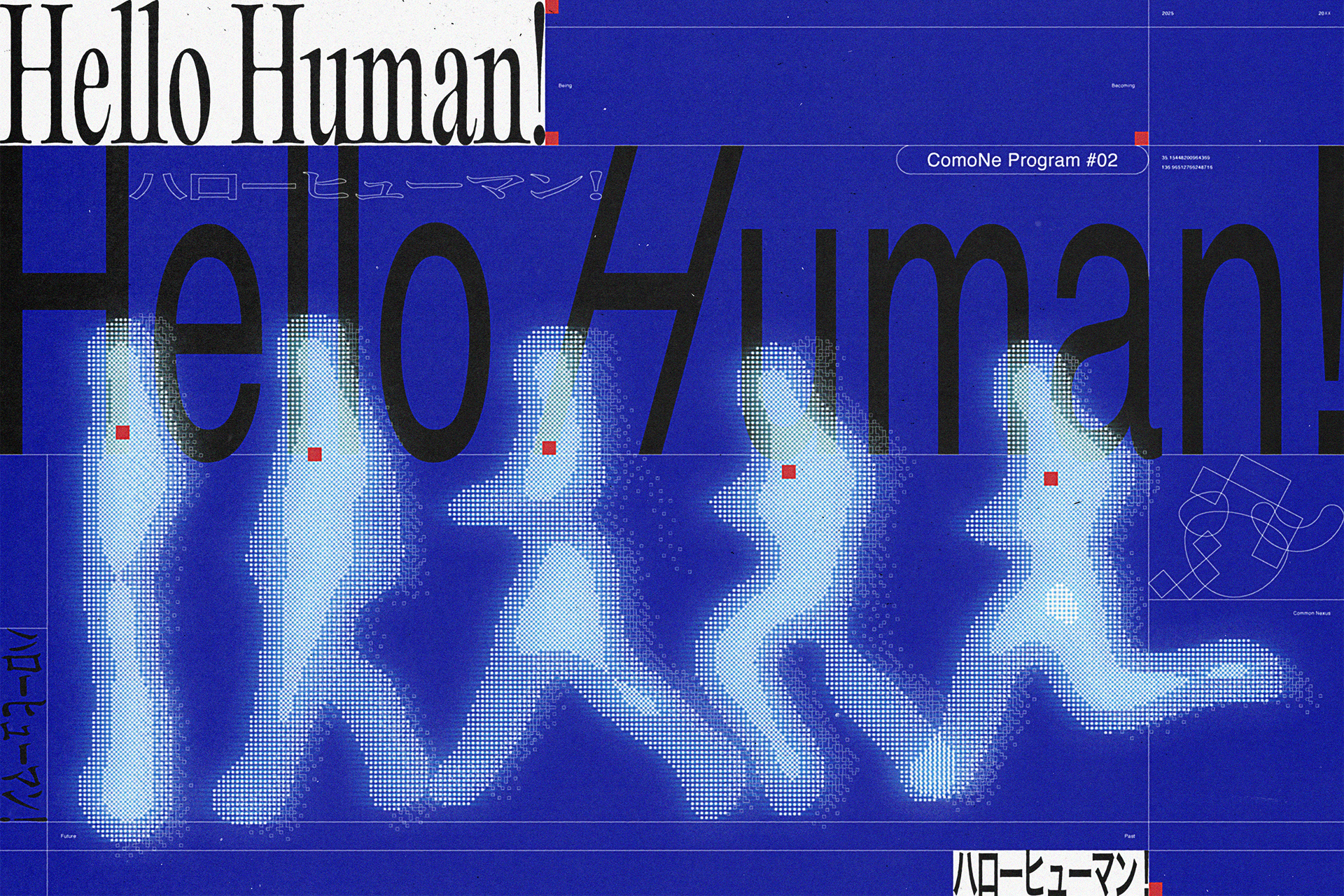
Announcement of Selected Works and Projects
ComoNe Program is a curated collection that sets cross-disciplinary themes and brings together works and projects from around the world for public presentation.
The theme of this second edition is “Hello Human!” A total of 47 works and projects were submitted.
In an era swirling with environmental crises, rapid technological advancement, and intense transformations,
how can we, as human beings, remain human?
Ten works and projects were selected for their ability to offer perspectives that gently yet meaningfully update the way we approach the coming era.
The selected works and projects will be exhibited at Common Nexus from April to September 2026.
Theme Owner
General Comment by Theme Owner
In an age when AI assumes cognitive labor, the environment is narrated as data, and machines begin to acquire sensory capacities, the question “What is a human?” is no longer abstract philosophy—it is an urgent and ongoing reality.
While technological progress expands our capabilities, it simultaneously destabilizes the very contours of what it means to be human. For this reason, this program did not seek works that simply celebrate or reject humanity. Instead, we looked for works that encourage us to reconsider humanity in all its contradictions and incompleteness.
What the selected works share is not merely a high level of technical refinement, but a perspective that looks back at the present from the vantage point of the future. Each work unsettles human perception and embodiment, questioning the senses and relationships we have unconsciously taken for granted. In these works, technology is neither merely a tool nor a threat. Rather, it is presented as something that interacts with humans and rewrites relationships anew.
“Hello Human!” is not a simple affirmation of humanity. It is a question posed from the gaze of the future: even within a changing world, what does it mean to be human? The selected works offer concrete responses to this question through rediscovering perception and redesigning relationships.
As we merge with technology, what will we feel, choose, and create? The works gathered in this program do not present answers. Instead, they function as devices for sustaining the question itself.
We hope that ComoNe Program #02 “Hello Human!” will become a modest yet certain catalyst for those of us living amid transformation to reimagine the future.
Selection Committee
Selected Works & Projects
Jam Dipper(Koken Arakawa)
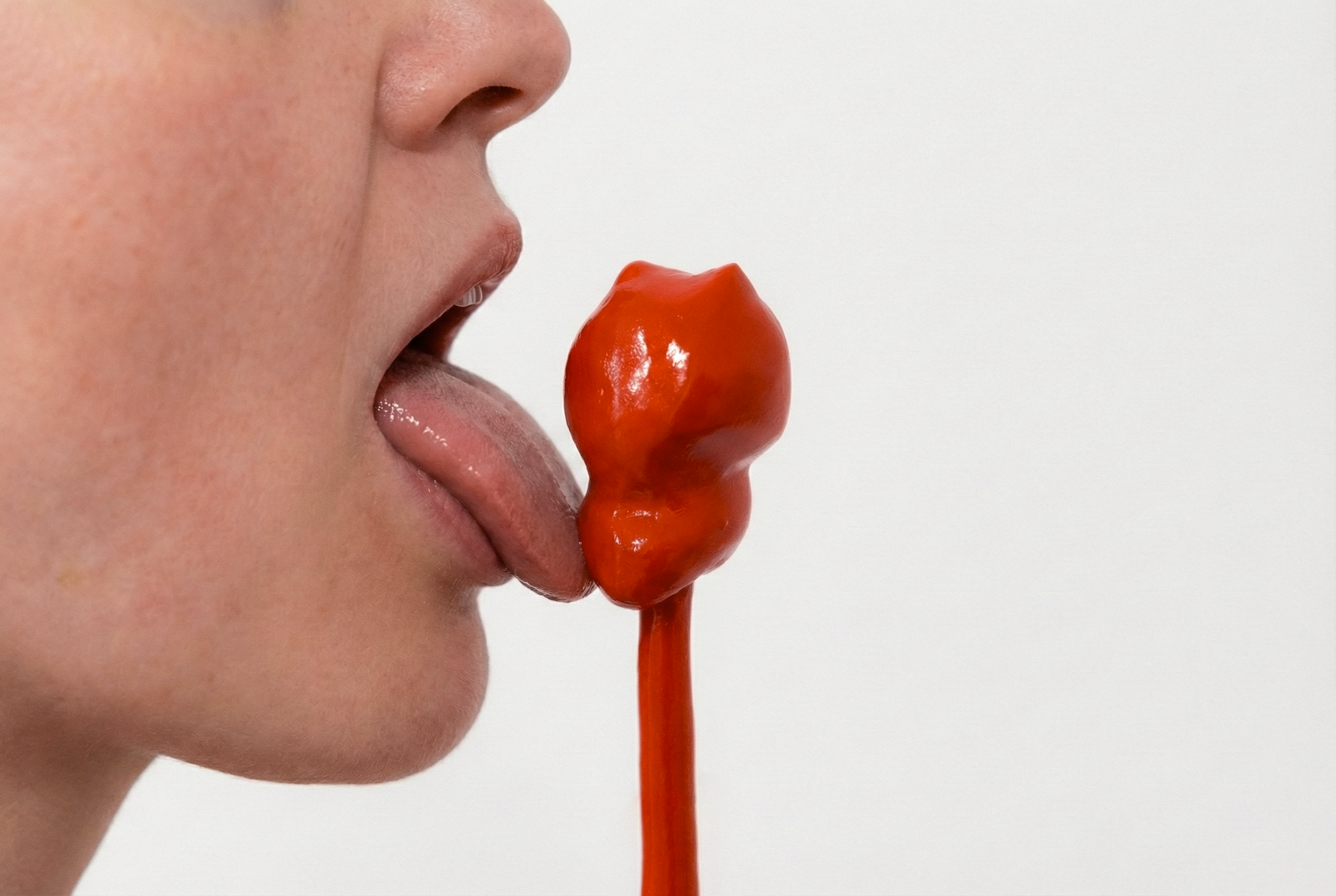
Jam Dipper is a wooden sculptural object coated with lacquer. While it anticipates being experienced through the tongue, it invites a form of “pseudo-contact” through what might be called the “tongue of the eye.”
The “eye” captures the external world from a distance, while the “tongue” is an entrance to the visceral interior. By overlapping these two organs, the work emphasizes the latent “slipperiness” hidden behind vision. The movement of the tongue exists on the boundary between voluntary and involuntary action. Tracing the smooth surface of Jam Dipper reverses the direction of consciousness—from the outside world, through the oral cavity, back toward the perceiver themselves. The viewer encounters deep bodily sensations—physical feedback generated within the body—and eventually meets a pre-verbal, undifferentiated sensation.
Such visceral sensations are closely linked to emotion, which is directly tied to survival. In a future where humans merge with AI and artificial entities, these sensations may be reconfirmed as the power that receives information from the outside world and sustains life. Just as sensing cold allows us to avoid death, the writhing sensations evoked through the tongue and touch may become essential information for navigating the future world.
Furthermore, for “future us,” this sensation may go beyond mere survival-based information selection. The emotional sensations encountered through the tongue could become a means of empathizing with animals and plants—fostering coexistence. As AI and artificial objects become agentic entities, we may treat them horizontally alongside animals and plants, sensing what environments are livable and creatively shaping them together.
Jam Dipper becomes an oral experimental field for exploring the perception and emotion of “future us.”
On the Web
https://wondrousjam.arakawakoken.work/Koken+Arakawa/Koken+Arakawa+(EN)
Selector’s Comment (Yuri Yoshida)
By inviting viewers to trace a small lacquered object with the tongue—experienced visually in practice—the work questions bodily perception and modes of appreciation. Amid accelerating virtual reality technologies, this palm-sized sculpture powerfully unsettles bodily sensation and expands our imagination of new relationships between artwork and viewer, AI and artificial entities.
CHROMA LIFE PROJECT(Masaya Sugiura)
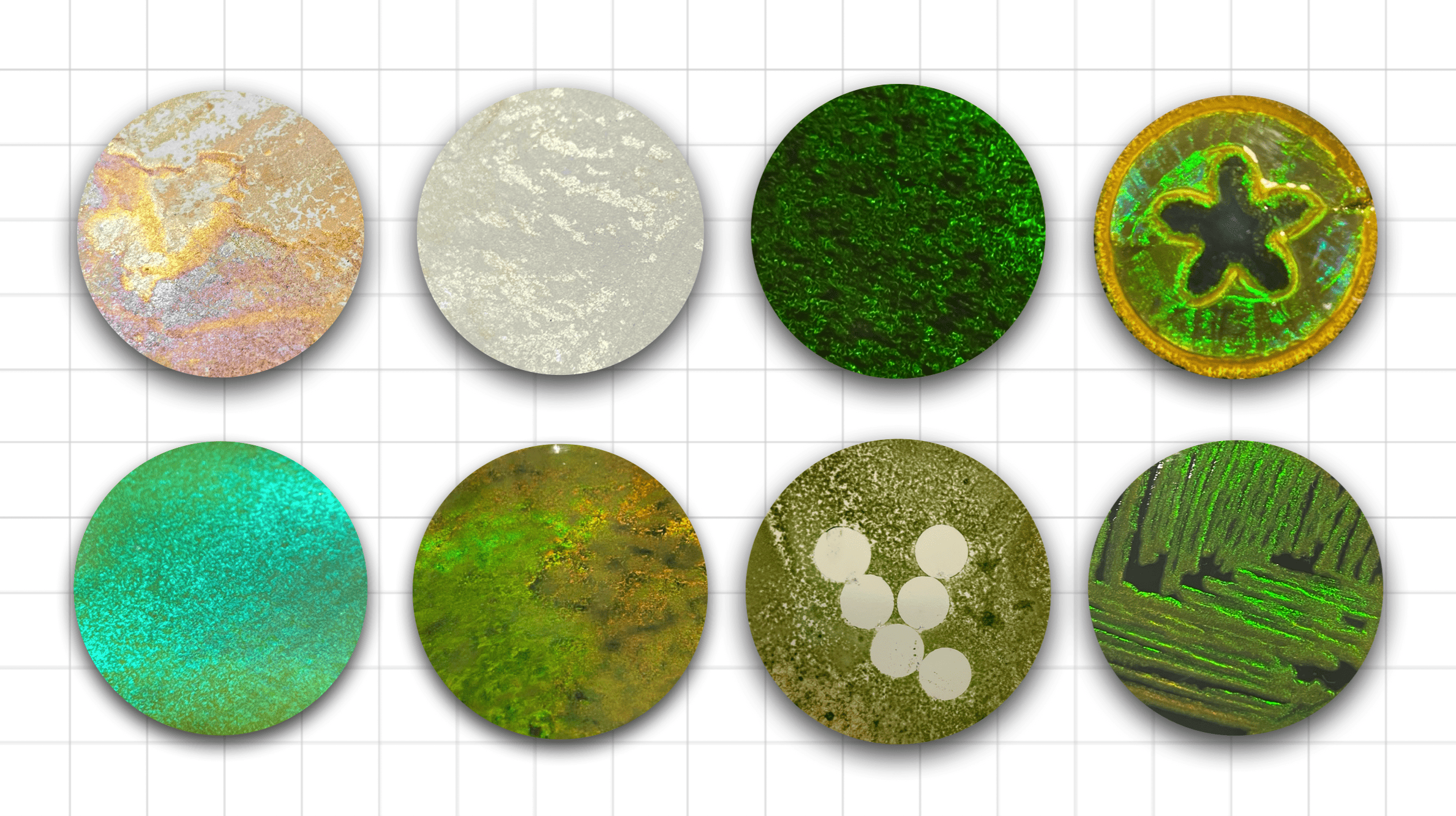
CHROMA LIFE PROJECT applies biodesign to letterpress printing from a circular design perspective, exploring sustainable and innovative possibilities in print technology.
The project developed bacteria-derived bio-ink that achieves both biodegradability and vivid coloration. Furthermore, the ink enables dynamic design expressions whose color and texture shift with changes in light and humidity. The project extends beyond technological development into workshops fostering social exchange, product development leveraging bacterial growth characteristics, and new media expressions themed around ecosystem building.
Respecting the craftsmanship and historical context of letterpress printing, the project seeks to fuse tradition and innovation. By redefining printing through the lens of life processes, it envisions a medium that coexists with people, the environment, and time—moving beyond mere reproduction.
On the Web
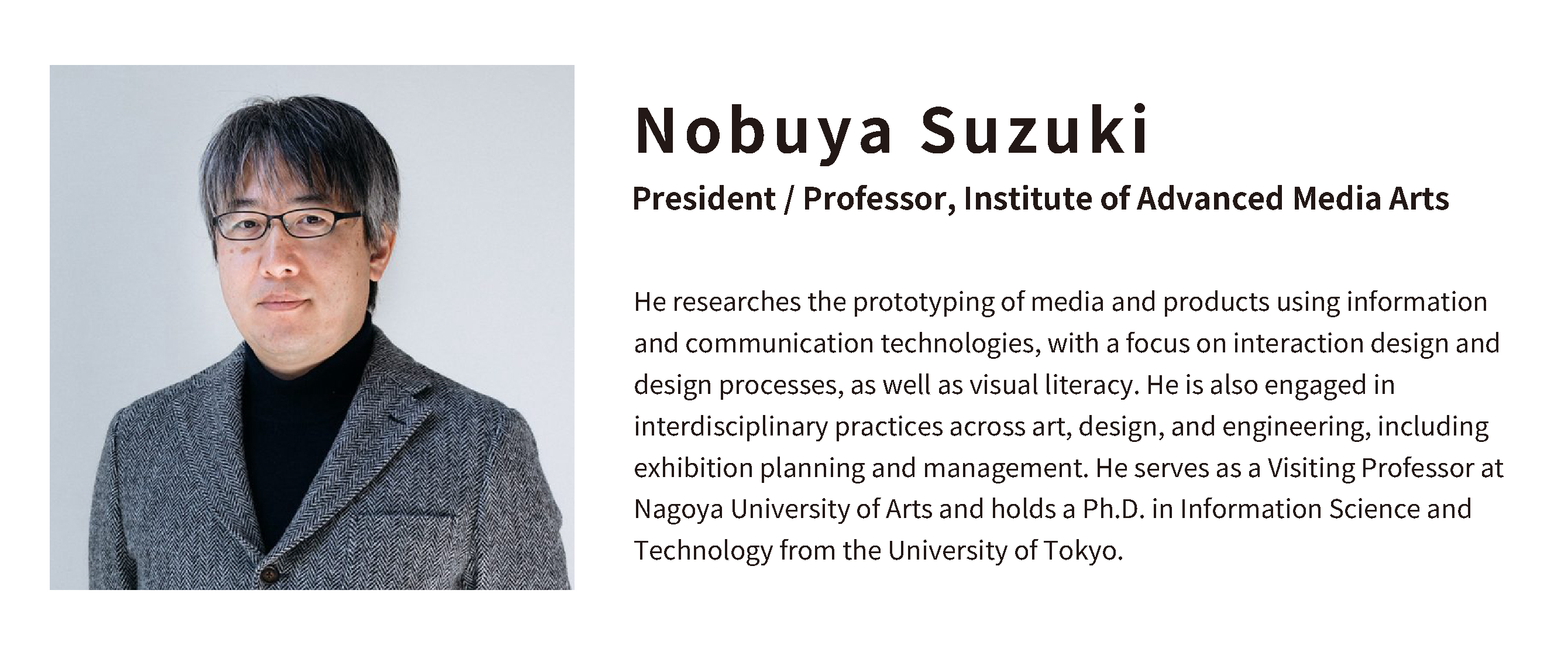
Selector’s Comment(Nobuya Suzuki)
By connecting biodesign with the historical technology of letterpress printing and reconstructing it through a circular society perspective, the project demonstrates strong originality. It expands printing from a fixed reproduction technique into “a medium that changes over time,” while also extending into social practice through workshops and ecosystem-based expression.
超未来考古学(超未来考古学会)
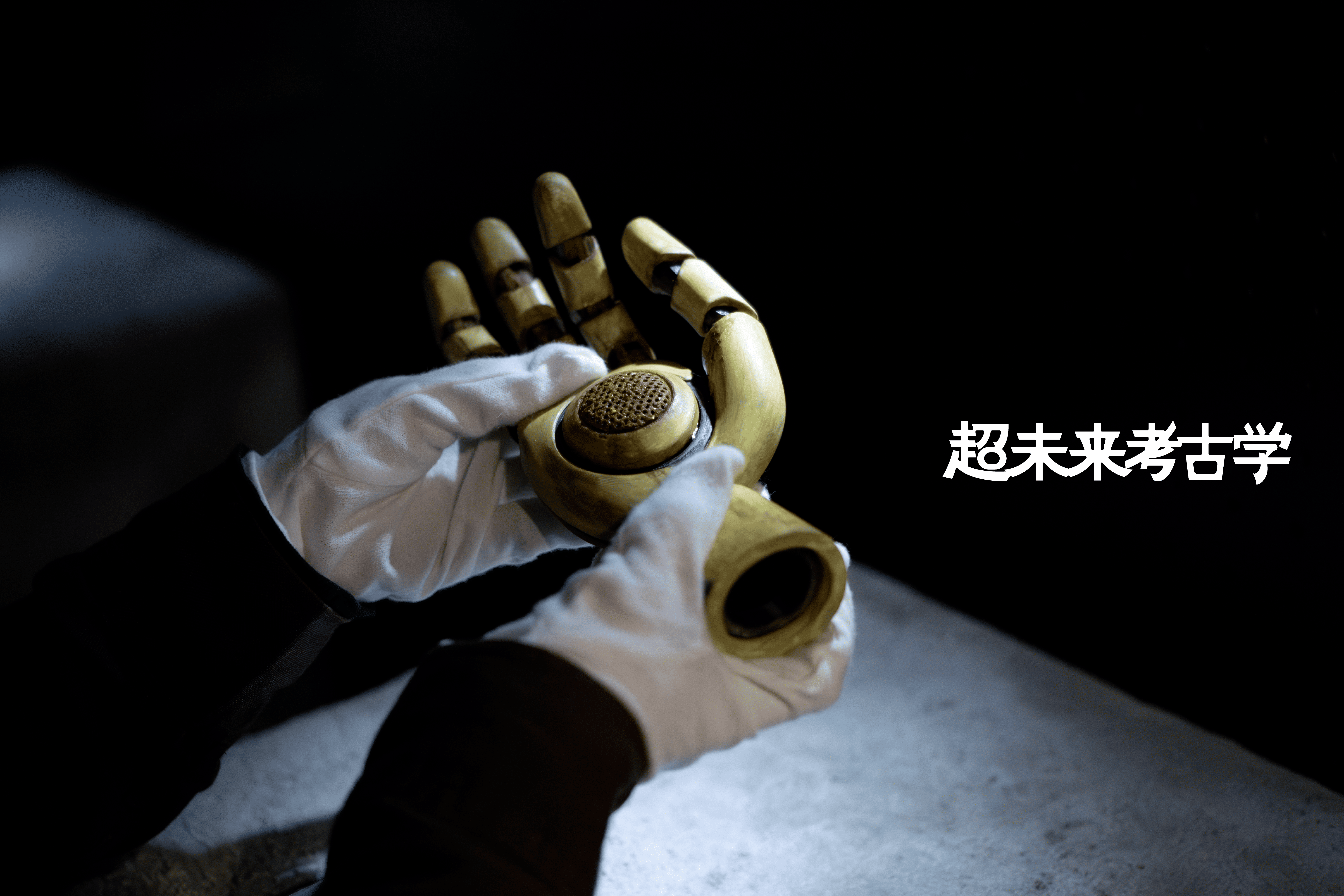
超未来考古学explores how fictional future products might be rediscovered after their roles have ended due to environmental and social changes.
Rather than stopping at the creation of speculative future products, the project imagines their full lifespan—use, deterioration, weathering, oblivion, and reinterpretation.
Focusing particularly on “sound-producing products,” termed onki, the team created physical prototypes set within imagined future societies. After aging treatments and staging excavation contexts, AI performed archaeological reinterpretations of these objects. These were exhibited as if curated by androids (AI) after the end of civilization, positioning visitors as “excavators.”
The project does not aim to predict or propose the future, but to function as a critical device that observes the human act of “making the future” from a reflective distance.
On the Web
https://www.instagram.com/ufas...
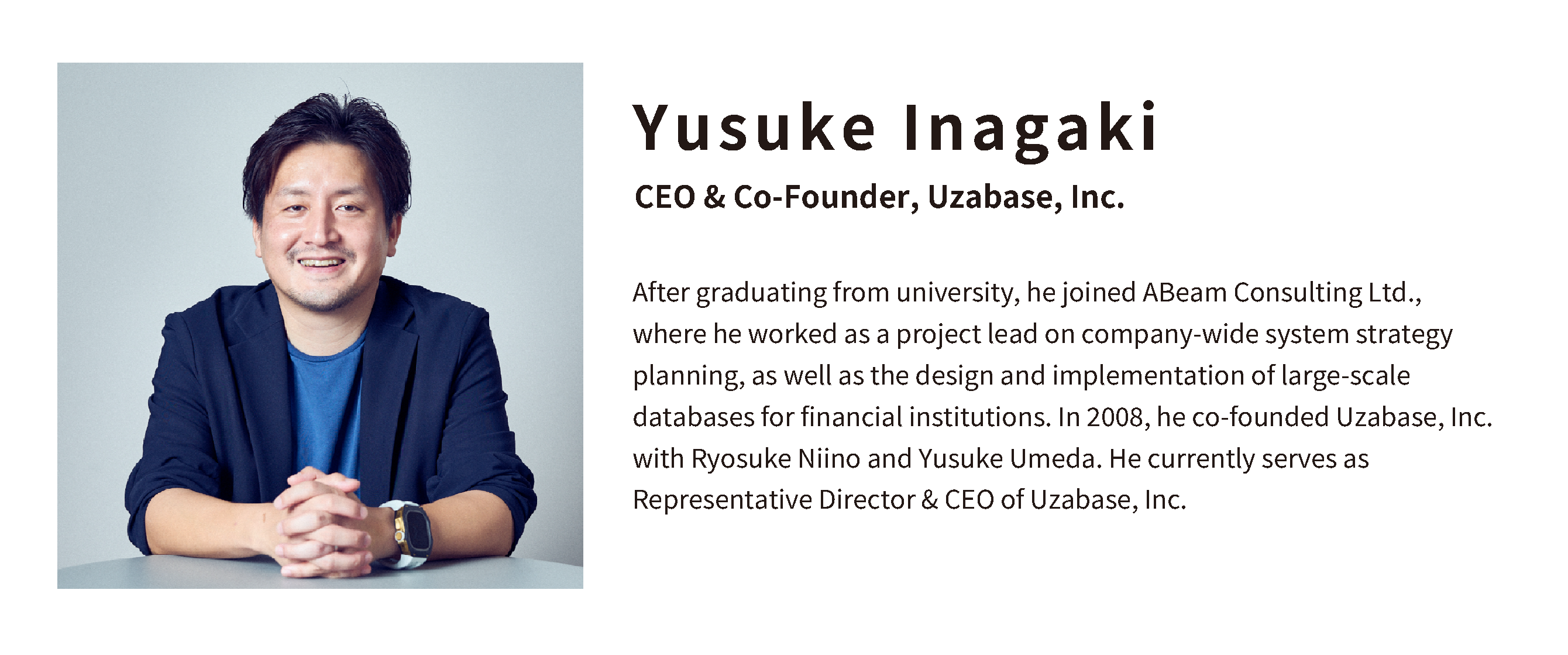
Selector’s Comment(Yusuke Inagaki)
In an era shaped by generative and physical AI, the act of tracing evolution backward from the future resonates strongly with the theme “Hello Human!” AI is not an enemy, but a technology for harmonizing with humanity. This work encourages viewers to imagine pathways toward a brighter future.
Hair Scape(抜け毛景観学)
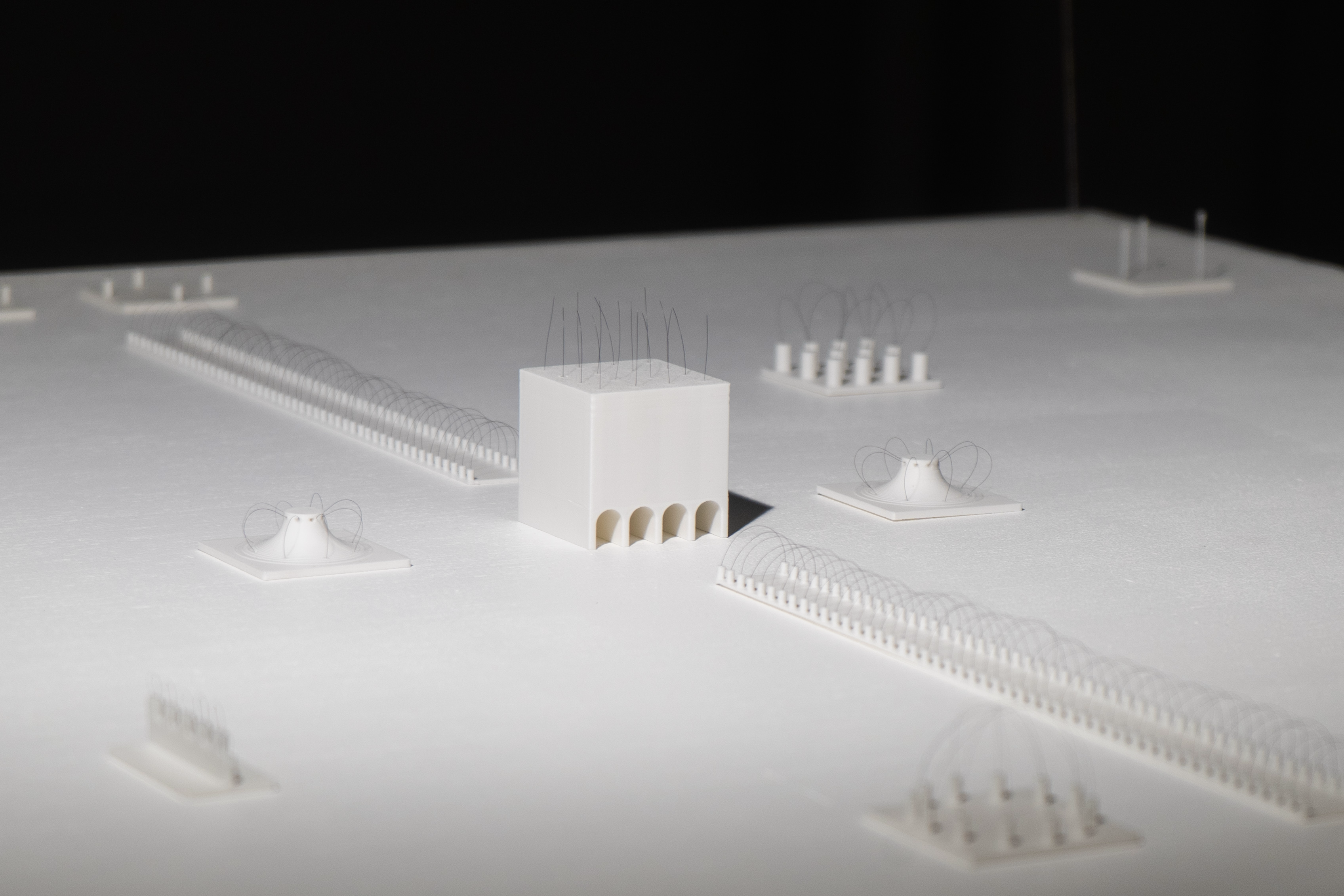
Hair rising from the scalp resembles architectural columns; yet once fallen, hair loses its structural meaning. This project attempts to restore dignity to fallen hair by giving it a new “scalp.”
Scattered hairs are gathered, a sculptural scalp is designed, and the hairs are reassembled. By revealing their structural beauty, fallen hair transforms from bodily residue into landscape.
On the Web
https://www.instagram.com/nukegekeikangaku
http://sites.google.com/view/nukege/page
Selector’s Comment(Yuri Yoshida)
Hair Scape – 抜け毛景観学 is a unique endeavor that constructs a world where the body and architecture intersect.
From the moment hair—once part of the body—falls from the scalp, it transforms into a different material: “fallen hair.” In this work, it is reimagined as a structural element supporting architecture within an imagined urban (round)scape. What may at first glance appear playful, even childlike, reveals through its delicate craftsmanship and expression a remarkable shift in scale—moving effortlessly between the micro and the macro.
The perspective and humor that enable such a grand transformation are imbued with distinctly human wit and ingenuity.
QUENELLE 感覚つながる小型EV(Momoko Noguchi)
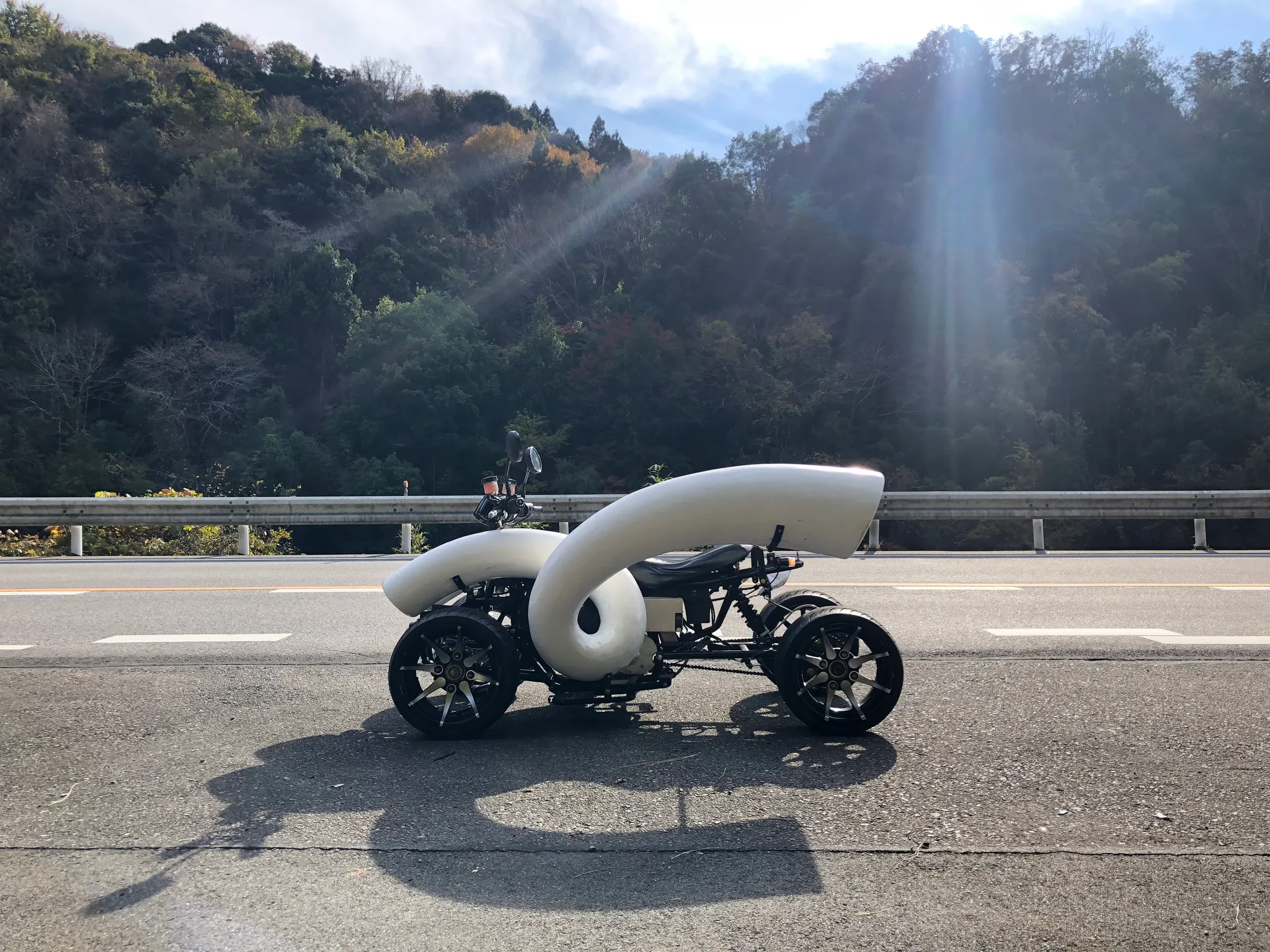
“QUENELLE (Kuneru)” is an electric vehicle that detects the rider’s heartbeat and converts it into sound, light, and vibration, sending these signals back to the driver. At the same time, the state of the vehicle is also presented to the rider as sensory feedback. Through this process, people engage with the car not through numbers or alerts, but through bodily sensation.
When driving a car, have you ever felt as if the vehicle were becoming part of your own body? In such moments, the boundary of the body seems to expand, and the tool begins to feel like an extension of oneself—something often described as “body extension.”
This work asks what might happen if such bodily extension became more sensory and reciprocal. By transferring the “pulse,” a symbol of life, to the vehicle, QUENELLE attempts to reconfigure the relationship between humans and inorganic matter. At the same time, it functions as a mobile social experiment that travels to “meet” diverse people in different places.
On the Web
https://momokonoguchi.com/
https://www.instagram.com/momokonoguchi
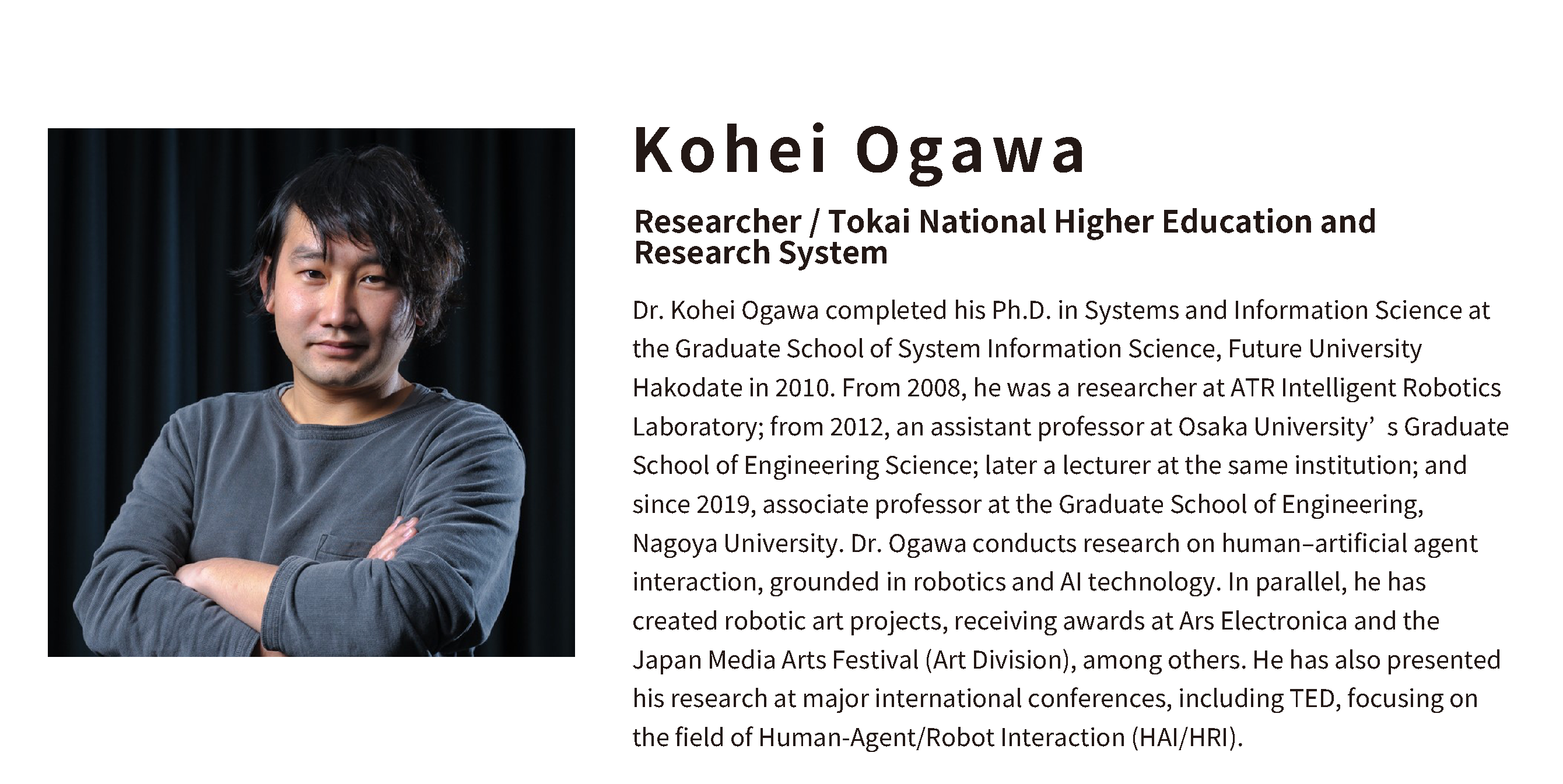
Selector’s Comment(Kohei Ogawa)
In an era in which AI and autonomous agents continue to evolve, this work proposes not an expansion of intelligence, but a fusion of sensation.
QUENELLE circulates the rider’s heartbeat and the vehicle’s condition back and forth as sound, light, and vibration, constructing a bidirectional sensory circuit between human and machine. Within this exchange, the machine is no longer merely a tool; it holds the potential to become a resonant presence.
By building relationships through movement, the project offers a compelling and concrete exploration of how humans and agents might coexist in the future, and was highly valued for articulating this vision.
Young Muslim’s EyesCrosswork between Arts and Studies(Young Muslim’s Eyes)
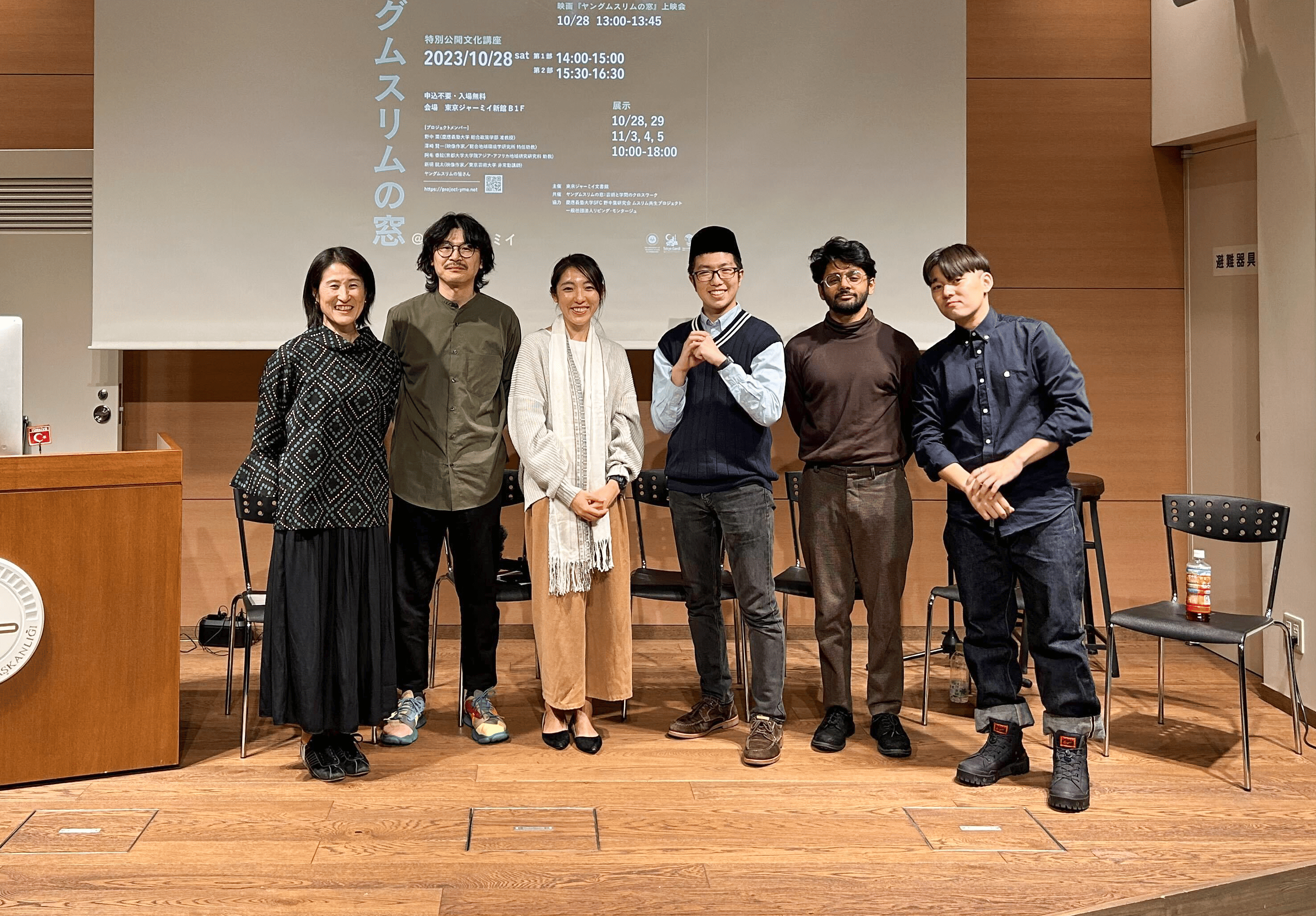
The project “Young Muslim’s Eyes” invites young Muslims living in Japan to create video works grounded in their own lived experiences and perspectives, and to share them with wider society through exhibition.
Each participant begins by asking, What do I want others to see through my eyes? By filming and editing their own narratives, they move beyond the singular and often reductive image of “the Muslim,” offering instead a plurality of everyday realities, values, and relationships. Through these works, audiences are encouraged not simply to look at young Muslims, but to look with them.
The process of creation and exhibition is itself collaborative. Participants, researchers, and facilitators work together across differences in position and background, engaging in sustained dialogue and mutual reflection. In doing so, the project fosters a space of shared learning—one in which seeing becomes an act of encounter, and perspective becomes a bridge between communities.
Project Members:
Kae Amo (Cultural Anthropologist / Assistant Professor, Graduate School of Asian and African Area Studies, Kyoto University)
Kenichi Sawazaki (Artist, Film Director, Curator / Project Assistant Professor, Research Institute for Humanity and Nature)
Yo Nonaka (Local studies / Associate Professor at Keio University)
Shuta Shinmyo (Filmmaker, Tokyo University of the Arts)
Ahmed Alian(CEO, Rhetica Inc.)
Yunus Ertuğrul(A member of society, Ezaki Glico Co., Ltd.)
Mamoru Hasegawa(Local community studies, Keio University Student)
On the Web
Selector’s Comment(Ai Hasegawa)
During this round of evaluation, I viewed a video portraying the personal journey of an individual who grew up in the culturally symbolic setting of a Japanese public bathhouse and later converted to Islam. It was deeply compelling to witness how religion, in this context, functioned once again as a foundation for human connection. At the same time, the work reminded me of the simple, genuine joy of taking interest in others whose cultural backgrounds differ from one’s own.
At a moment when exclusionary attitudes seem increasingly visible, this project offers an alternative vision—one that embraces the inner worlds of others rather than rejecting them. In doing so, it sketches a future in which diverse systems of value intersect and coexist.
To rediscover the ordinary, everyday life of a neighbor who feels both close and distant—and to take a step toward entering that world—requires imagination and openness. This work profoundly embodies that expansion of empathy toward others.
AI Graphic Notation(Kazuyuki Miyamoto)
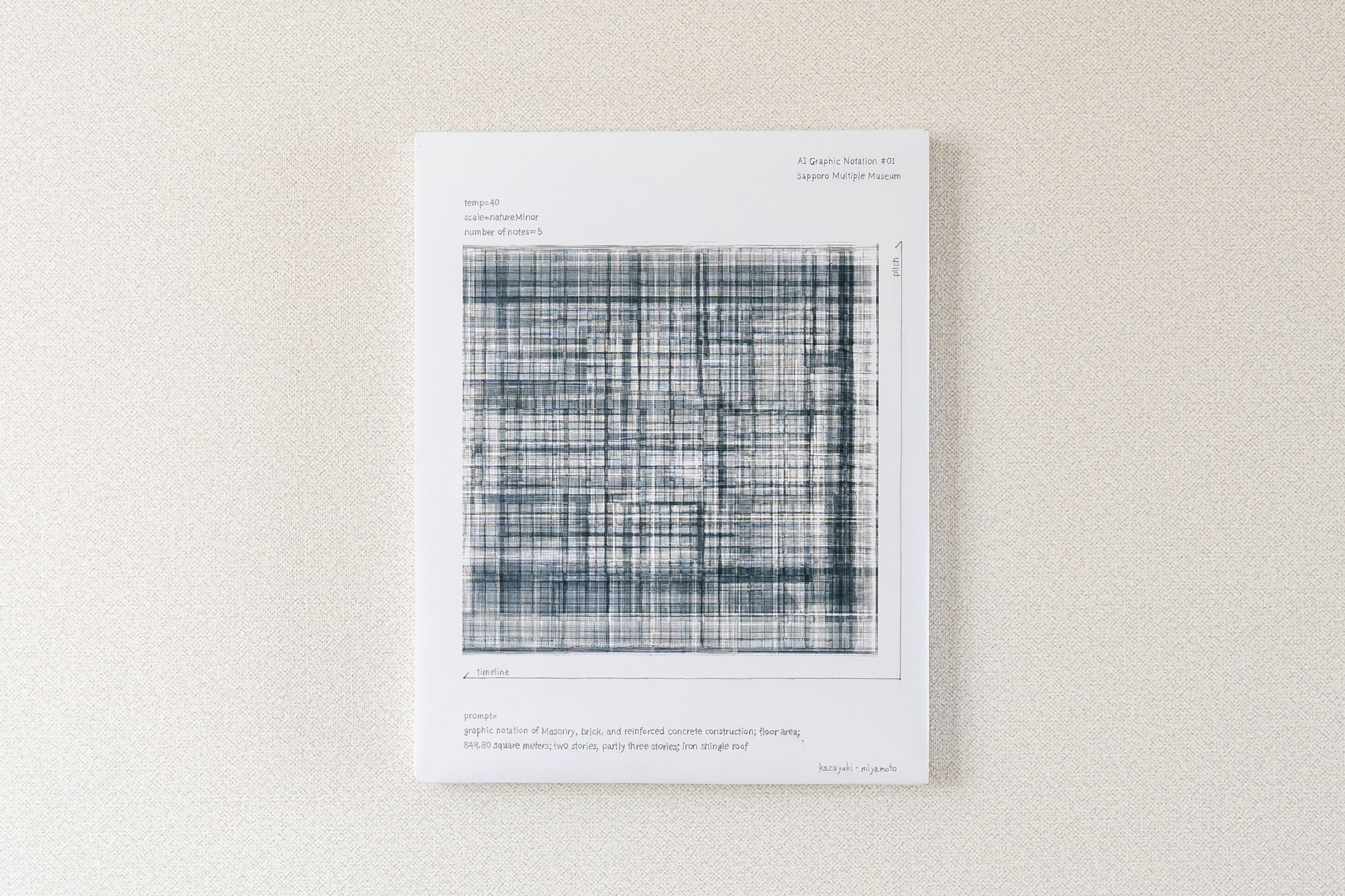
This sound work was created through collaboration between a human and an image-generating AI.
The project begins with the input of prompts describing characteristics of an existing building—its materials, structure, floor area, architectural style, and other features. From these prompts, the AI generates a diverse set of images intended to represent the building. These images are then integrated and translated into graphic scores, which in turn are performed as sound.
The work consists of three prototypes: an acrylic record, a tactile object, and a graphic score in which musical instructions—tempo, pitch, and timbre—are inscribed directly onto the generated images. Drawing on the tactile experiences and sensations derived from the first two prototypes, the completed graphic score is ultimately rendered into sound through programmed performance.
A central intention of the project is to incorporate the possibility of mutual misunderstanding between AI and human as an expressive element. Within the work, the AI never produces an image that precisely corresponds to the actual building. Likewise, when I interpret and perform the graphic score, I inevitably fail to realize the sound the AI might have “intended.” Rather than sustaining a one-directional relationship—where a human issues commands and the AI responds with precise, intended outputs—both AI and human diverge from one another’s trajectories.
Historically, humans have often reinterpreted such errors and noise not as failures but as sources of creativity. This work explores that space of deviation and misalignment as a productive condition, seeking possibilities for a creative, reciprocal relationship between machine and human in the age of AI.
On the Web
http://www.kazuyuki-miyamoto.com/
Selector’s Comment(Nobuya Suzuki)
This work stands out as a unique attempt to present the collaborative relationship between an image-generating AI and a human as a sound-based artwork. By translating images—generated through prompts describing architectural characteristics—into graphic scores, and then rendering them into sound through programming, the project unfolds through a multilayered process that traverses vision, touch, and hearing.
Particularly noteworthy is its deliberate refusal to eliminate misalignment or misunderstanding between AI and human. Instead, such discrepancies are actively embraced as sources of creativity. The work critically dismantles the conventional one-directional model of command and response: the AI does not accurately reproduce the architecture, and the human performer does not realize the sound exactly as the AI might have “intended.” By foregrounding this divergence, the project articulates a reflective and critical stance.
In doing so, it presents an ambitious exploration of creative reciprocity in the age of AI, suggesting new possibilities for human–machine collaboration beyond precision and control.
Primordial Reality: Relive the baby's mind and body
(Taisuke Murakami/Collaboration with Shoko Kimura(Architecture and Design, Faculty of Engineering, Graduate School of Engineering, Nagoya Institute of Technology)、Ayaka Fujii( Guardian Robot Project, RIKEN ))
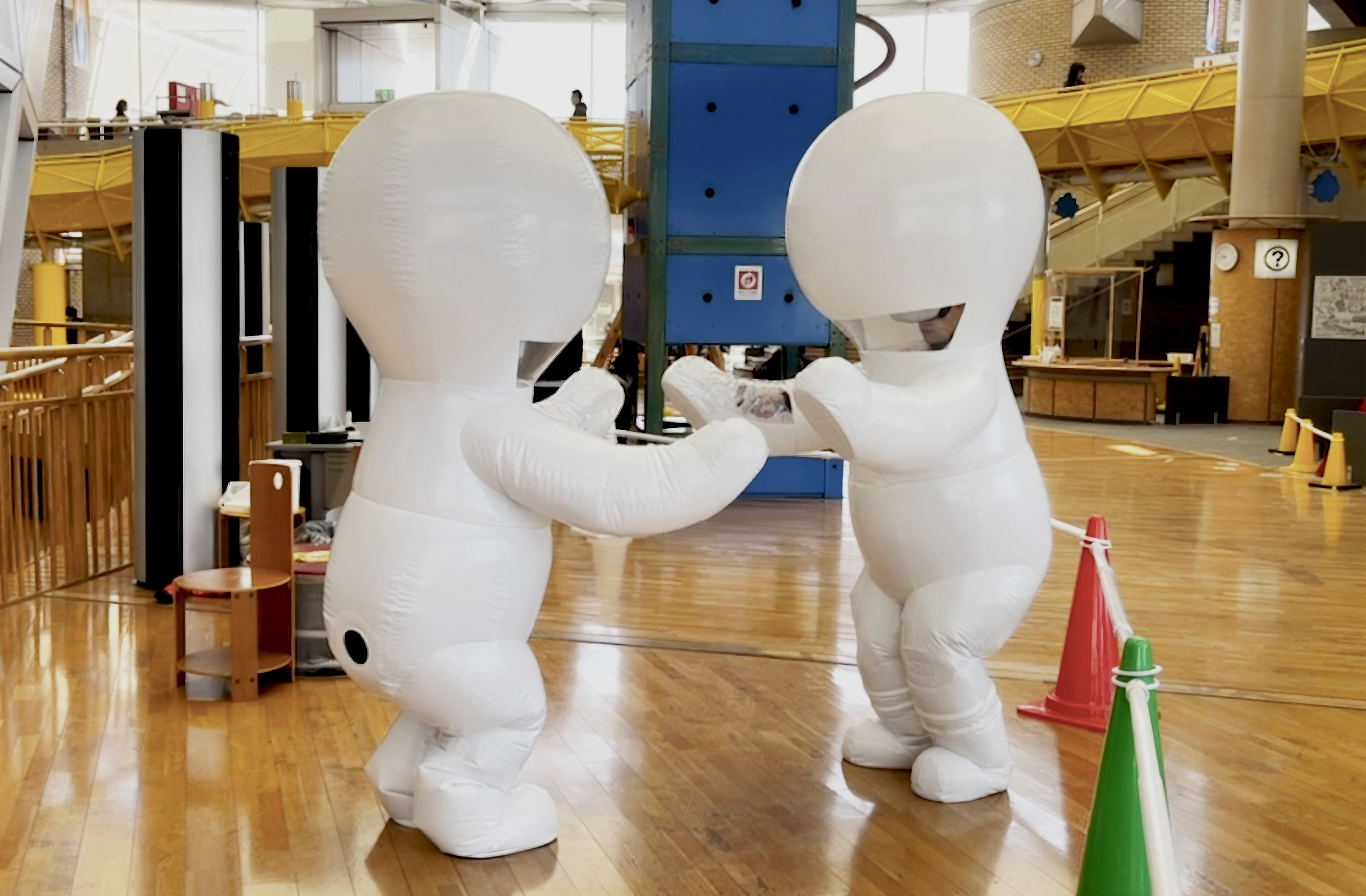
This work is an attempt to re-experience the primordial sensations we once felt at the very beginning of life—by coming into contact with the body and mind of a baby.
The experience is created through virtual reality and a specially designed bodysuit made of a soft, membrane-like material. Together, these elements reconstruct a sensory environment that invites participants to inhabit a different mode of being.
Even when we occupy the same physical space, each of us receives and interprets the world in profoundly different ways. Yet in our daily lives, we tend to forget this. We were all once babies. And yet, we cannot clearly recall how we saw, touched, or moved at that time. As we grow, the size of our bodies and our distance from the world change dramatically.
This work serves as a threshold through which adults can approach the sensory world of infancy once more. A blurred field of vision, a body that does not move as intended, a scale of the world that feels disproportionate—by physically experiencing these conditions, we are reminded that what we take for granted as “normal” perception is not the only way of sensing the world.
Through this experience, the work quietly invites us to recognize that there are many different ways of feeling and inhabiting the world—and that within those differences lies the richness and diversity of human existence.
On the Web
Selector’s Comment(Kohei Ogawa)
When we look at the present from the vantage point of the future, what may be called into question is not the finished form of the human being, but its plasticity.
By inviting participants to re-experience the bodily sensations of an infant, this work unsettles the perceptual norms and sense of scale we take for granted. Blurred vision and restricted movement remind us that the human condition was once fundamentally open-ended—an existence not yet fixed, but full of diverse and latent possibilities.
Through the body, the work reopens the question of what it means to be human. For its capacity to reconsider the present from a future-oriented perspective, and to foreground human malleability rather than completion, it was highly regarded as a significant and thought-provoking endeavor.
記憶は、誰のものか 〜Whose Memory Is It?〜(Olfactory / Natural Scent Designer, Mikiko Yamamoto)
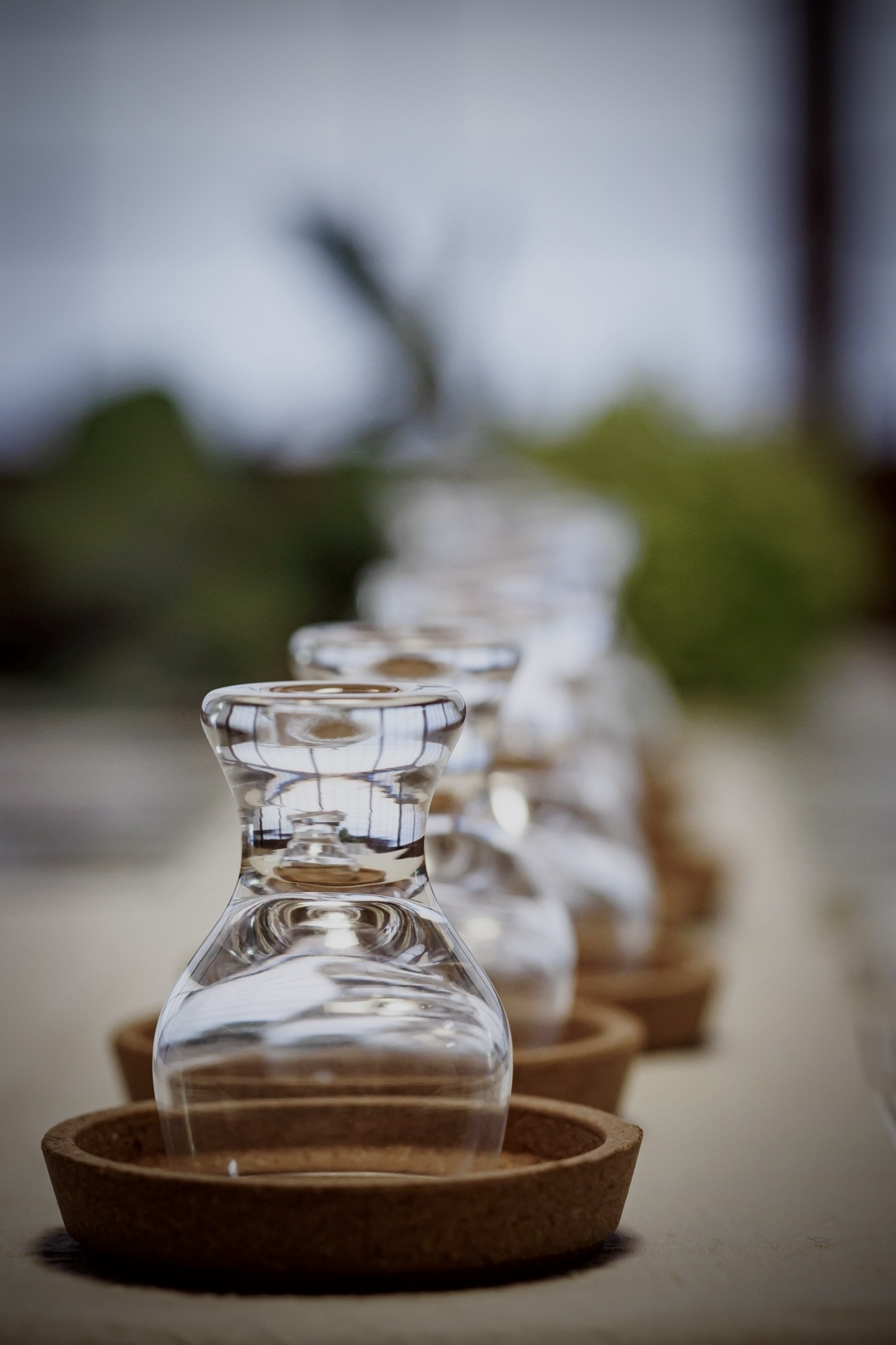
This work is an olfactory installation that experientially reexamines human memory and cognition through the sensory medium of scent.
While scent can be described or even chemically reproduced, the experience of it remains irreducibly individual and indeterminate. Even when inhaling the same fragrance, each person arrives at different memories and sensations. Moreover, these impressions are easily influenced by the words or presence of others. Rather than treating such discrepancies and fluctuations as flaws, the work presents them as intrinsic to the very structure of being human.
Visitors first encounter brief fragments of memory left behind by others. They then smell a single scent and attend to the sensations that arise within themselves. Finally, they choose whether to leave their own memory within the exhibition space or to carry it home. There are no correct answers, no evaluations, no analysis or optimization.
The work neither abandons nor wholly affirms the human condition. Instead, it lingers within its contradictions and instabilities, continuing to search for meaning. Perhaps this very posture—holding ambiguity while remaining open—is a modest yet vital renewal of what it means to be human in the age to come. In this sense, the installation becomes a quiet olfactory response to the future’s call: “Hello Human!”
On the Web
https://www.instagram.com/atoy...
Selector’s Comment(Ai Hasegawa)
Rather than pursuing the mechanical accuracy of data, this work’s commitment to the subjective and fluctuating nature of “the scent of memory” gestures toward a domain of human experience that may remain irreducible in an increasingly digital future.
By attempting to share a sensory world without correct answers, the project affirms a distinctly human ambiguity—one that exceeds efficiency and optimization—and in doing so, it opens a space for rich imagination. In a contemporary landscape saturated with visual information, an experience grounded in embodied perception powerfully evokes deep empathy for the unknown terrain of another person’s memories.
Through the five senses, the project rearticulates the contours of human existence, reminding us that meaning is not only processed, but felt.
DULLTILE BOX - Dullness Tactile Box(Yuto Yoshihara)
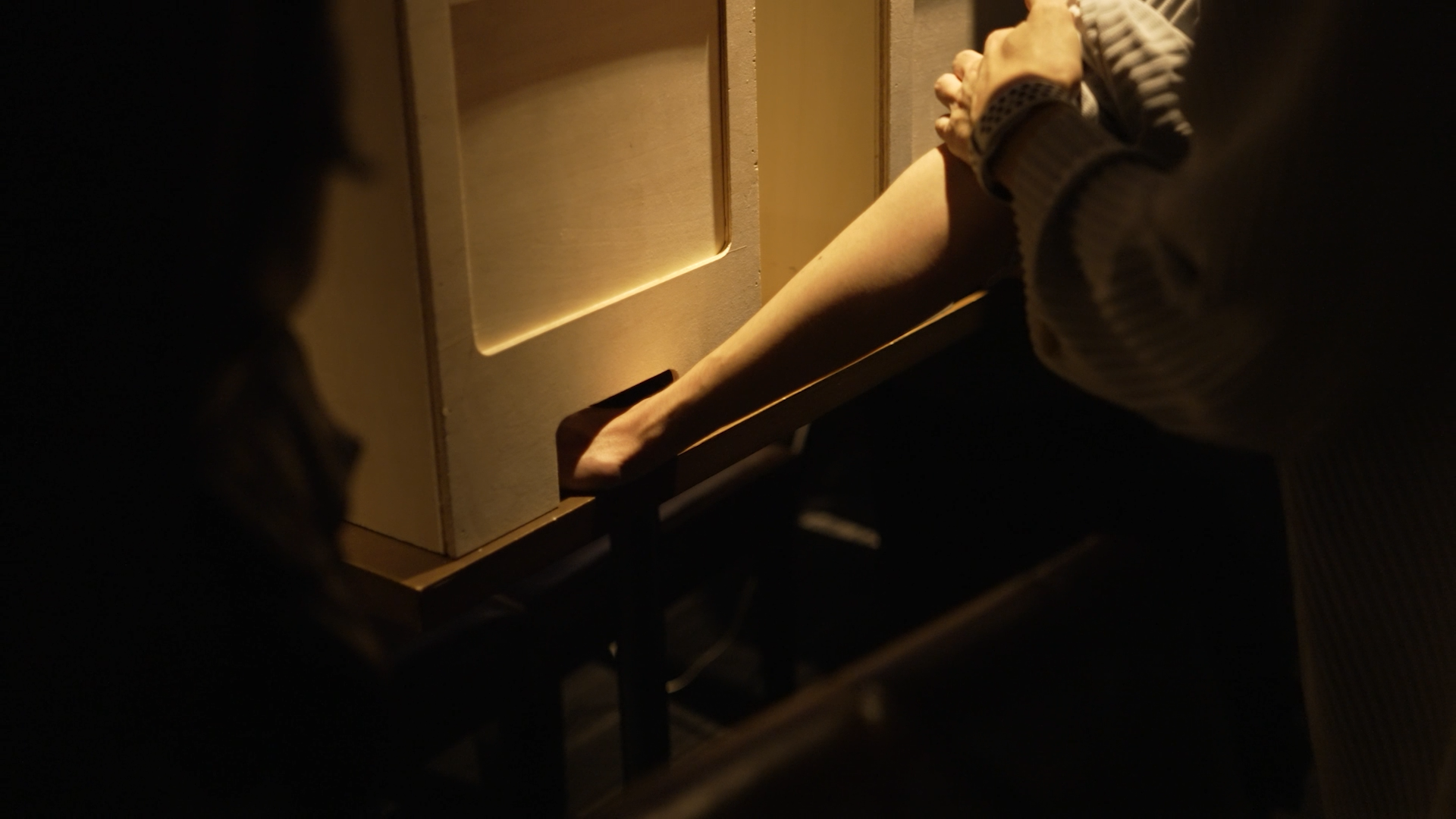
The back of the hand is less sensitive than the palm and tends to perceive the boundaries between objects as blended or indistinct.
By embracing this “dullness” as a positive quality, we created a box that allows users to experience sensations in which the boundaries between materials seem to dissolve into one another. Various materials and movements are combined and applied to the back of the hand, generating a tactile experience where edges feel ambiguous and fused.
We call this new tactile sensation perceived through a less sensitive part of the body “DULLTILE” (Dullness × Tactile).
By placing the back of the hand facing upward inside the box, visitors can experience DULLTILE.
Research Collaboration: Hikari Miura
Production Collaboration: Maki Furukawa
Exhibition Collaboration: Masaru Yajima
On the Web
https://yuto-yoshihara.notion....
Selector’s Comment(Nobuya Suzuki)
This work is exceptionally distinctive in its focus on a specific bodily characteristic: the fact that the back of the hand is less sensitive than the palm and tends to perceive boundaries as blurred or intermixed. By foregrounding this “dullness,” the project transforms what might typically be regarded as a limitation into a positive experiential value.
Where many tactile explorations aim to enhance precision or discriminability, this work deliberately embraces ambiguity and fusion. Through carefully combined materials and movements, it generates sensations in which edges seem to bleed into one another. The simple yet decisive shift—from using the palm to using the back of the hand—fundamentally alters the mode of perception itself.
In doing so, the project redefines touch: from a sense primarily oriented toward identification and distinction to one that welcomes blending and indeterminacy. This conceptual and perceptual reframing was highly valued.
Inquiry
For any questions or inquiries regarding your application, please contact us here. The Common Nexus office will respond to you.
