The winning designs for the HAPTIC DESIGN AWARD have been announced. Please take a look at the work from these “HAPTIC DESIGNERS”.
For more information on the winning entries, please visit the HAPTIC DESIGN AWARD website
HAPTIC DESIGN >> http://hapticdesign.org/
facebook >> https://www.facebook.com/hapticdesign.org/
Grand Prize: Ridge Line User Interface
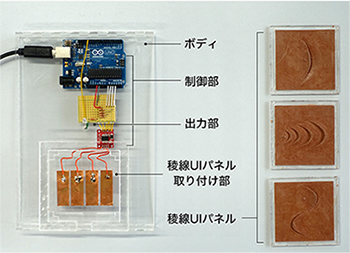
Concept:
The idea behind this prototype work is to create a new kind of switch interface.
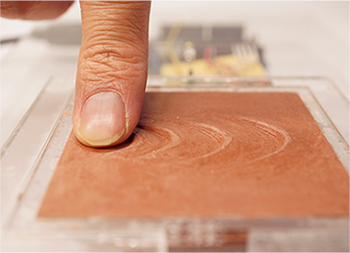
This interface consists of two or more touch sensitive areas. These are divided into “perceptual ridges” by physical bumps and partitions.
Unlike existing switches that can be operated by pushing a button, or touching a fixed area on a screen, this interface operates by sliding your finger across the “perceptual ridge way”, which also generates tactile feedback.
The design ensures mistakes caused by sudden accidental movements are less likely to occur, and through its simple construction, also brings a high degree of freedom to shaping its form.
With information provided both visually and by touch through three-dimensional modeling, this work breaks new ground in the field of user interface design.
Voices of Award Winners
Shigeya Yasui / Associate Professor, Department of Information Architecture, Future University Hakodate

The Ridgeline User Interface is a concept prototype for a new switch interface. Instead of "pressing a button" or "touching a designated surface" as with existing switches, it uses the action of "sliding a finger over a perceptual ridge" as the source of switch and tactile feedback. This allows for a high degree of freedom in modeling due to its simple structure, in addition to its resistance to unintentional malfunction. This work opens up a new world of information design that links the body and the environment from both a visual and tactile perspective through three-dimensional modeling.
Judges' Messages
Shinji Kawamura / Executive Creative Director, PARTY
I thought it was great that you added a new layer of interface by adding a simple haptic design to an existing switch. I can see the potential for a variety of applications, and I look forward to watching this concept develop in the future.
Yukio Ohya / Producer, Creative Company NAKED Inc.
A simple yet big idea that could change the structure of society as a whole. The simple but profound operation of not only touching, but also going beyond, gives it great potential as an input device. We operate countless switches in our daily lives. Even if you think about it for a moment, there are countless "switch boxes" in space. If these switch boxes were to disappear altogether, the design of the spaces we live in could be fundamentally changed.
Shinpei Takahashi / Representative, Rabbit Co.
It has the potential to create a completely new experience and lifestyle, and the fact that we could realistically imagine a future in which this is put to practical use is a high evaluation point. We also felt that the fact that it seems easy to develop the switch while experimenting, evaluating, and improving what kind of interface would create comfort was an excellent idea.
Eiichi Izumi / MINOTAUR Director / Designer
The range of materials, shapes, and occasions for various tactile sensations is huge, and I look forward to the versatility that I can't imagine right now. Personally, I would like to ask for switches for items that integrate digital and clothing, which are currently under development, and I am also attracted to the fact that you can conjure up vivid images from familiar places, just as I would like to live in a house with a switch without material switching on the wall. Smart operation is also in my mind's eye.
堀木 俊 / 隈研吾建築都市設計事務所
I can imagine various spatial effects using this device, and found it to be a very clear idea. The device could read the operator's feelings from his/her fingertips and create a response with the space that is different from the conventional operation of simply turning the device on and off. This is an excellent idea that, although only partial, can evoke the active touching of the object and project affection on the walls and floor.
Kota Minamisawa / Associate Professor, Graduate School of Media Design, Keio University (KMD)
People perceive the environment around them as tactile through the skin on the surface of their bodies. If the environment had a skin, how would the environment perceive people's actions? HAPTIC DESIGN encourages people's behavior by "making them want to touch" by putting an analog skin on top of digital technology.
First prize: Work/Model category – tsumishi
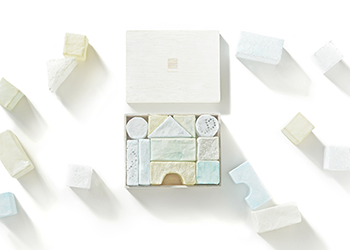
Concept
First, please try to remember how you hold a baby in your arms.
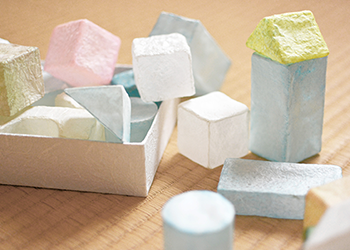
“tsumishi” are building blocks made from traditional Japanese “Washi” paper, that capture this feeling of a natural, gentle embrace.
Not only humans but many animals, when they are babies their bodies are small, their eyes are large and round, and this makes them seem adorable to us.
We are equipped with an instinctive need to protect them.
Because of this we act with a kindness towards all babies, and at the same time our movements become conscientious and careful.
Through this behavior the idea of making something delicate and fragile came to me.
The “tsumishi” are hollow, and appear transparent when held up to the light.
Different varieties of paper are used, so you can enjoy the subtle contrasts in color and texture.
If they can become a means by which we treat objects with more care, and help continue an aspect of traditional Japanese culture, then I will be very happy.
Voices of Award Winners
Minami Kawasaki / Tokyo University of the Arts
Target setting is very important when creating something, and there are many situations in which it is essential. However, I felt that deciding on the target first has become the "way" of design, and I felt somewhat uncomfortable with this. We all have emotions in common, such as happiness, sadness, and joy, although where we feel them is up to the individual. We can all touch things. This time, I took a hint from the habits of humans and animals in creating this work, and I aimed to create a work that could move the feelings of the people in the room, regardless of who it was directed at, by touching the boundary of the object, the piles of paper. I am very honored that you evaluated my work based on this idea. Thank you very much.
Judges' Messages
Shinji Kawamura / Executive Creative Director, PARTY
I felt that this is a wonderful haptics design that has the power of propagation so that you can imagine its fragility and delicacy just by looking at the pictures without having to touch it. I think it is wonderful that the design and the sense of touch even shape the interaction of the person playing with it. While there were many ideas that made full use of technology, this is a good example that it is still possible to create interesting designs using only analog elements.
Yukio Ohya / Producer, Creative Company NAKED Inc.
Just imagining playing with these building blocks gives me a kind of unique sense of fragility. I thought it was a wonderful concept that was constructed from the completely opposite image of the fragile approach of texture. The beauty of this work is that it makes you feel physiologically aroused even just by watching it.
Shinpei Takahashi / Representative, Rabbit Co.
I have always thought that building blocks should be something that can be handled roughly or put in one's mouth. I would really like to know what would happen if I let my child play with this product. If they learn to handle things gently, it would be a game changer for toys. I am deeply interested in this idea that could completely change the intellectual development and experience of children.
泉 栄一 / MINOTAURディレクター/デザイナー
I was strongly impressed by the fact that you can actually feel the sense of tactile imagery with sensations that can be grasped by the imagination without touch, and I think that HapticDesign is a tool that allows us to discover more interesting ways of perceiving things when put into perspective. I felt a kind of power to derive sensations.
Toshi Horiki / Kengo Kuma Architecture & Urban Design Office
It is not a forced sense of touch, but a relationship in which the person experiencing the product thinks about the other person's condition with consideration. I also felt that by inserting the perspective of the body's unique gesture of Japanese-ness, a very appealing product was created. This ephemeral object draws out the sleeping body's senses, and the project has a high degree of perfection and skill as a single project.
Junji Watanabe / Senior Researcher, Human Information Research Department, NTT Communication Science Laboratories
When we touch an object, we expect the object to support our power. Piled paper betrays such expectations and makes us conscious of the act of "touching" without even knowing it. It is considered an excellent haptic design that makes us realize the sensation and act of our own touch.
Ideas category – LIP SERVICE
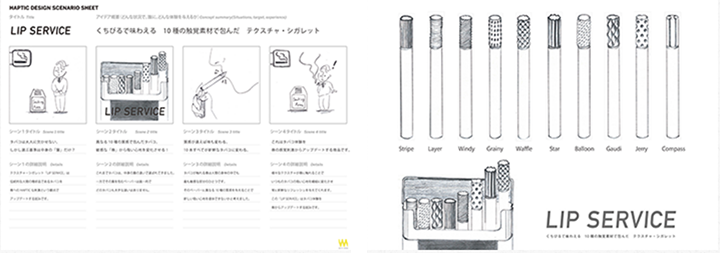
Concept:
The texture cigarettes “LIP SERVICE” are an attempt to update a product that’s been traditionally the favorite of many people, by bringing the stimulating perspective of HAPTIC to their lips.
By wrapping cigarettes in ten materials with different textures, smokers can savor a variety of sensations.
Until now, people have chosen their cigarettes based on differences in the quality of tobacco they contain.
However, the paper wrapping this tobacco has been almost uniformly the same.
Lips that touch a cigarette are one of the most sensitive parts of the human body.
By experiencing various textures, the sensation of smoking a cigarette subtly changes, and we get a fresh, revitalizing feeling each time.
Voices of Award Winners
Kyoko Kita / Kentaro SAKO / Dentsu Communication Designer / Panasonic Product Designer
LIP SERVICE is an attempt to update the traditional tobacco cigarette into a "textured cigarette" that also provides HAPTIC stimulation to the lips. Cigarettes are enjoyed frequently throughout the day, and because it is a product that touches the delicate mouth area, we felt that tactile design was important. It is still in the concept stage, but we hope that the HAPTIC DESIGN AWARD will be an opportunity for us to realize this project.
Judges' Messages
Shinji Kawamura / Executive Creative Director, PARTY
I don't smoke and I don't like ideas that promote smoking, but this had the power to make me want to give it a try. I think it would be interesting to explore more the relationship between the sense of touch and taste and the design that creates an interaction there, and I thought this was an example of that.
Yukio Ohya / Producer, Creative Company NAKED Inc.
I have always been uncomfortable with the cold or plasticky feel of metal in vape products, but this seems to be a solution to that problem. I found the direction of a palatability preference very appealing.
Shinpei Takahashi / Representative, Rabbit Co.
I think the lips are the most sensitive tactile part of the body, but there are many possibilities for changing the "texture" of a cigarette. Perhaps there could be a texture that would give the same satisfaction with fewer cigarettes smoked, as opposed to a wider range of tastes, or a texture that would enable people to quit smoking. It is an idea that has the potential to create new value over a wide range.
Eiichi Izumi / MINOTAUR Director / Designer
The habit of smoking cigarettes or chewing gum to refresh oneself can now be refreshed without putting it into the body through the sensitive sense of touch from the lips, and this can be an eco-friendly, healthy, and smart way to improve habits and bad habits. It is expected to become a self-care item for both body and mind. It contains many opportunities to expand its development.
Toshi Horiki / Kengo Kuma Architecture & Urban Design Office
As I looked at the work, I couldn't help but actually suck what was there on my lips, and realized that cigarettes might actually be pacifiers for adults. I looked at my dumb face through the reflection of the glass as I sucked at random, and I thought, "I've been had. It is very interesting to see it as a new refreshment tool to change one's mood by putting it in one's mouth, rather than limiting its utility to smokers.
Kota Minamisawa / Associate Professor, Graduate School of Media Design, Keio University (KMD)
If you imbued various types of wood with various scents and sculpted them like this proposal, people would probably keep sucking on them. My mouth was already watering while judging, and I feel that appealing to HAPTIC could create not an extension of cigarettes, but a new alternative to cigarettes.
good piece of work
Artwork Category | Hirune de Soro
Team at! (Shin Hanagata, Hiromi Kinomoto, Yuki Kosasa, and Yuki Kato) Keio University SFC, A&T
When you lie on it, the device makes you feel as if you are lying on the battlefield of the Warring States Period. The device reproduces the realism of a battle with left and right speakers and a vibrator installed on the back of the backrest. LEDs on the underside of the hat placed over the face of the user's head blink to show the shadows cast by the soldiers and horses passing overhead.
Artwork Category | COVER
Yoshie Kuroda / artist
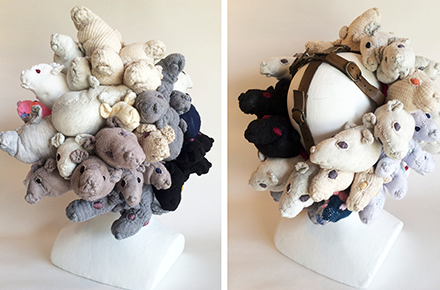
There is a term for this: "mask addiction." There seems to be a psychological need to distance oneself from communication with others by covering up. However, the act of covering has another effect. However, the act of covering up has another effect: anonymity loosens up the rational mind and makes it easier to expose the parts of the mind that are normally suppressed. The other is that the person who is covered up is "like a talisman to hide himself or herself and gain psychological peace of mind. The other is as a "cover to reveal the true nature within". These should take completely different forms for each person. The COVER series is based on the theme of the ambivalence within people that is revealed by the act of covering.
Artwork Category | connect project
Satoru Ohira / Artist
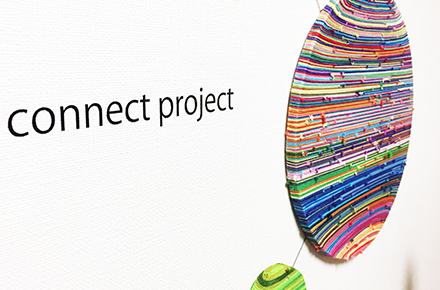
connect projectThis is a project to connect the leftover threads of sagari-ori weaving, which is done at workplaces where people with disabilities commute to throughout Japan. Various people will join the leftover threads of sarori weaving done in each region, and connect them together to form a form. The threads will be connected through art, and will create new value by connecting the threads to a future with diversity.
Abstract representation of tactile sensation. And there is an unknown expression hidden in this work. It is an expression that can be conveyed to the visually impaired. When Braille as we know it today did not exist, there existed a type of writing called "Knot Letters. The knots in the strings were used to represent the colors, and the characters were recognized as letters. By touching the knots in this work, you can experience another unknown expression. It is not visually obvious what kind of abstract Braille expression will emerge from the randomly knotted Sasori threads. However, by touching it, just as if you were deciphering Braille, you will be able to feel the unknown aspects of this work. Regardless of whether you have a disability or not, this is art that can be communicated through the sense of touch. We will design the value as a new HAPTIC art.
*Sori weaving is one of the simplest hata-ori weaving techniques, created by an Osaka housewife, Misao Shiro, in 1972. The meaning of the name comes from the weaving in of the individuality and sensibility of each person, in other words, "weaving the difference. The philosophy of "Sasori weaving" can be summed up as "drawing out without teaching" and "weaving as you wish.
www.artsaori.net/about_sawori.html Currently, because of its simplicity, it is being adopted throughout the country as a work for people with disabilities.
Artwork Category | WIM
Jun Kamei, Kate McCambridge, Jacob Boast / Royal College of Art
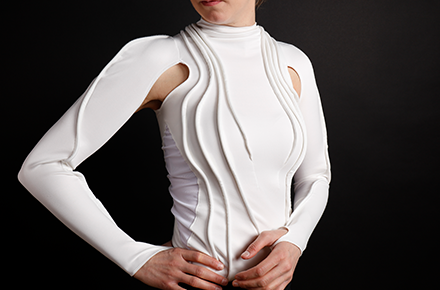
WIM is a suit that can share (download/upload) information on implicit body movements directly to the body. Because it is based on artificial muscles, sending movement data causes the joints and chest to stretch and vibrate to reproduce that movement, allowing the wearer to intuitively feel the movement. Because it is soft like clothing, it can be designed to blend into everyday life and can be used for rehabilitation, motion learning for athletes and dancers, and as an assistive suit for the elderly. As an additional development, we envision a WIM platform that allows real-time sharing of movements to multiple people, a function to record movements, and people trading information about their body movements.
Idea Category | "Wearable Pom-Poms" for tucking children in bed
Kenichiro Shirota / ARATANAL IDEA/CONCEPT/STORY/COPY
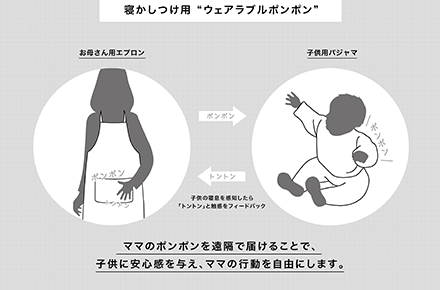
Remote Pom-Poms Help Moms Raising Babies! When putting babies to sleep, we often touch them on the back to reassure them, but the reality is that moms are busy and may want to make phone calls or cook during that time. This item allows mothers to move on to the next activity after the baby has been put down for some time. When she touches the pocket of the apron while doing housework, the vibration and feeling are remotely transmitted to the baby's back. This item gives the baby a sense of security and frees the mother both behaviorally and mentally.
Idea Category | Touch and Play Karuta
Mika Fujikawa / Product Development Department, Kutsuwa Corporation
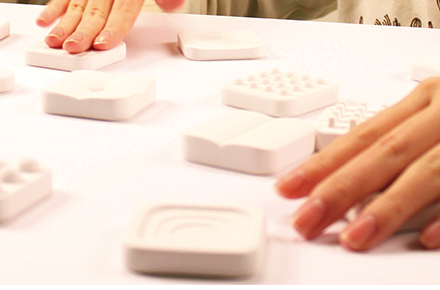
Touch and Play Karuta" is a karuta game that can be played with the visually impaired. The cards are written in Braille so that visually impaired children can also play. In addition, all the cards are pure white to make it easier to understand what they feel on their skin. The words used for reading cards are words such as "chikuchiku" and "puyopuyo," which allow the reader to imagine the texture of the cards. We hope to create an opportunity for people to learn about "gitaigo" (mimetic words), which are expressions unique to the Japanese language, while playing the game, and to become aware of the interesting textures around us. Through "Touch and Caruta," we hope to expand the circle of communication and create a world in which there is no distinction between "able-bodied" and "handicapped" people.
Idea Category | How Far To Touch?
Minatsu Takekoshi / NPO Mission ARM Japan
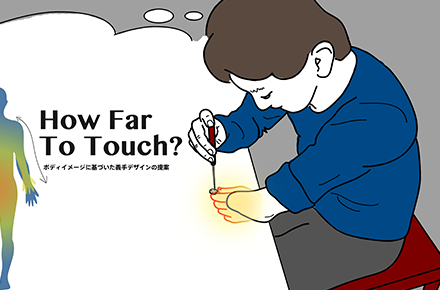
How far should I extend my arm when I touch something around me?" We move our bodies based on our unconscious awareness of the spatial relationship between ourselves and the outside world. This bodily sensation is body image. This idea is a proposal for a prosthetic hand design for people with congenital upper limb defects that emphasizes the physical sensation of touching, grasping, and pushing. By attaching a prosthetic hand with the length of the "udder in the body image" that the user has developed since birth, rather than imitating the "udder that was supposed to be there skeletally," we believe that it will be possible to extend the user's original sense of touch more seamlessly.
Idea Category | hands of Kasa bukuro kun
Yusuke Matsumoto / Planner, Advertising Company
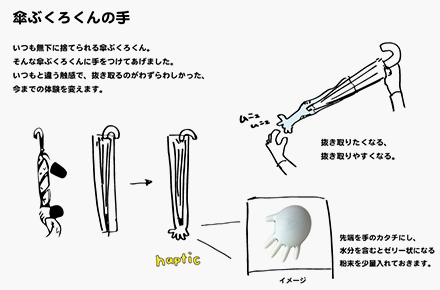
When a thing is equipped with HAPTIC, people will feel affection toward it. Even if an object is usually bothersome, the HAPTIC, a raw tactile sensation that can be recognized from its appearance, may change the way people behave. On a rainy day, I saw plastic bags of used umbrellas being thrown away in a mess and wondered if there was anything I could do about it. The heap of plastic bags looked sad and disposable. The reason for this was the dreariness of rainy days and the difficulty of removing the soaking wet plastic bags. By putting a baby-like hand on the umbrella bag, we brought out feelings of wanting to pull it out and touch it, as well as functionality that makes it easy to pull out. The tactile feeling of the baby-like hand, created by the rainwater dripping from the umbrella, changes the way people behave.
Idea Category | Cross-Field Haptics
Satoshi Hashizume / Digital Nature Laboratory, University of Tsukuba
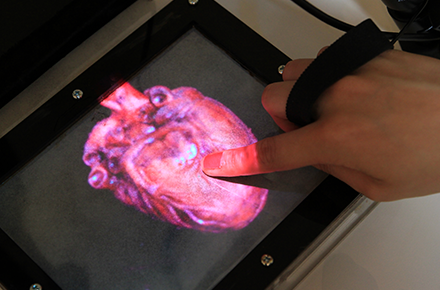
While conventionally, only a single physical field is used for tactile presentation, our work combines multiple physical fields for tactile presentation. In this work, we combine magnetic fluid and electrostatic adsorption. Magnetic fluid is a liquid whose viscosity changes when a magnetic field is applied, generating a pushing force, while electrostatic adsorption generates a pulling force between the finger and the screen when electricity is applied. In addition, this work can simultaneously present tactile sensations such as resistance, softness, and vibration. By presenting them simultaneously, it is possible to express textures of materials, living creatures, hearts, and other textures. The technology for presenting these textures is expected to be applied in educational and medical fields.
Idea Category | hapbeat
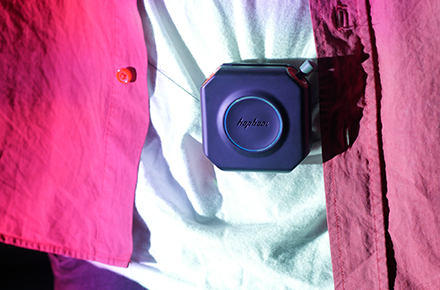
Yusuke Yamazaki / Managing Partner, Hapbeat LLC
hapbeat is a new wearable acoustic device. A reel of thread is attached to the motor, and the thread is wound around the body using a spring. The vibration generated by the motor is transmitted to the body via the thread, making the device wearable, lightweight, and capable of presenting vibration over a wide area. Body-sense acoustics is a system that enhances the impression of sound and deepens the sense of presence of music by making the body experience the bass component of music as vibrations at the same time as sound. For example, when you go to a live concert, have you ever felt the sound of people cheering or the heavy bass from the huge speakers? HAPBEAT is a device that allows you to easily experience such sensations.
