“AWRD meets GLOBAL CREATORS” (#AMGC) is a new interview series by AWRD, a platform that connects creators with projects. Under the theme of “new sensibilities,” the series spotlights emerging creators from around the world—designers, artists, and practitioners across diverse fields—exploring their creative practices and the cultures unique to their respective regions.
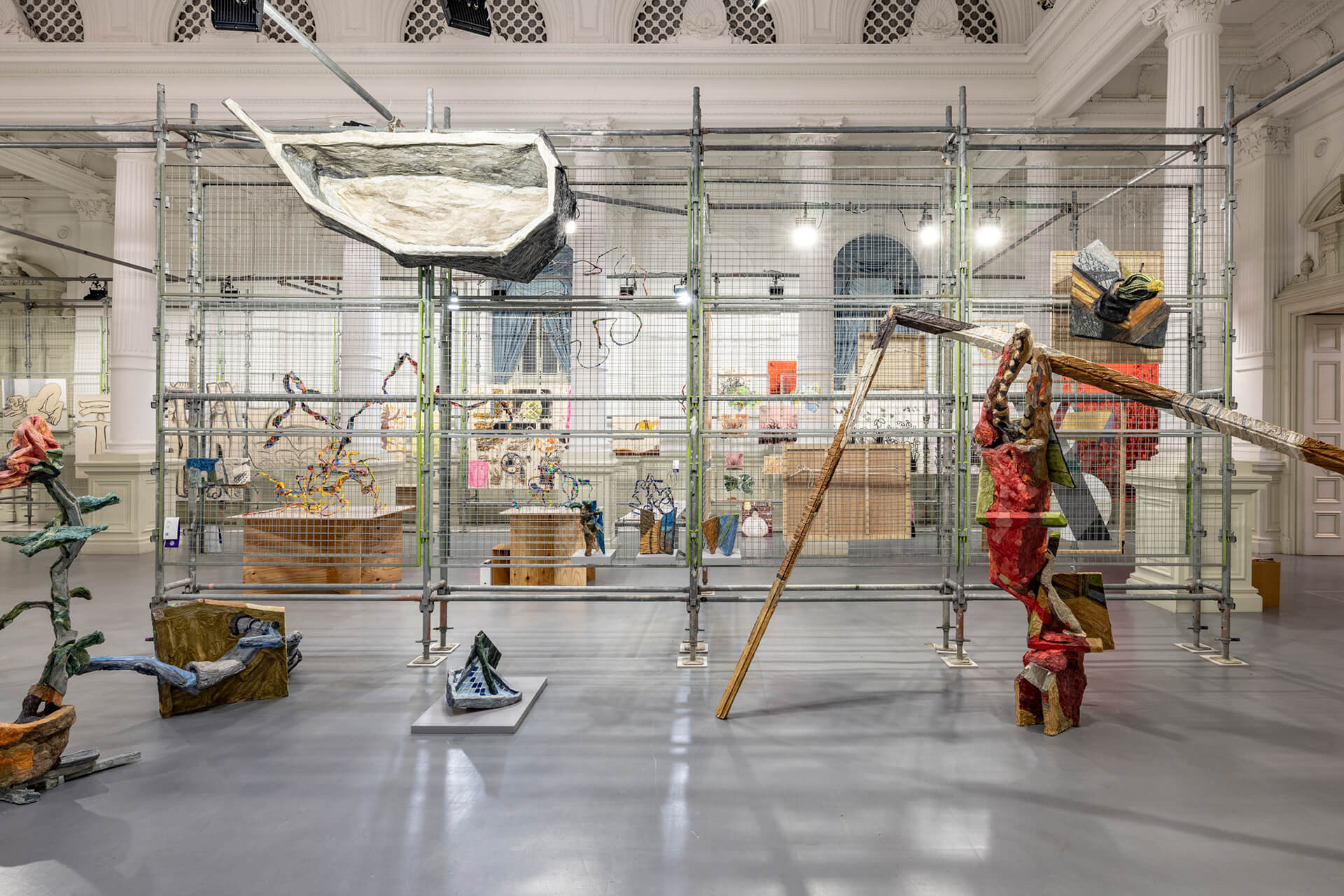
The twelfth installment features sculptor Keita Motooka. He has developed an original technique known as Wankyoku Hariko (Distorted Papier-Mâché), in which dyed paper is kneaded with a vinyl acetate–based resin and applied to molds. Through this process, he creates works that give rise to new forms at the boundary between two-dimensional and three-dimensional expression. Motooka is also set to hold a solo exhibition at Tofuku-ji Temple, the head temple of the Rinzai school of Zen Buddhism, starting February 20, 2026.
In this interview, we explore the background behind the development of his unique technique, his creative process rooted in a deep engagement with materials, and the challenges he hopes to pursue next.
—You developed an original technique called Wankyoku Hariko (Distorted Papier-Mâché). Could you tell us how it came about?
I began using this technique in 2020. Even before that, I had been creating sculptural works by pasting paper, but that year I started to thoroughly experiment with different ways of applying paper. At the time, I was a third-year university student, and due to the COVID-19 pandemic I was forced to continue my studies at home. Working with paper and adhesive allowed me to create without being constrained by space or time, and through an enormous number of experiments, I arrived at what I now call Wankyoku Hariko.
Shortly before that, I had begun to question the very act of making sculpture, to the point where I found myself unable to produce works. My hands would only move when making drawings or reliefs, and I think I was deeply afraid that my work would become too multi-directional or diffuse.
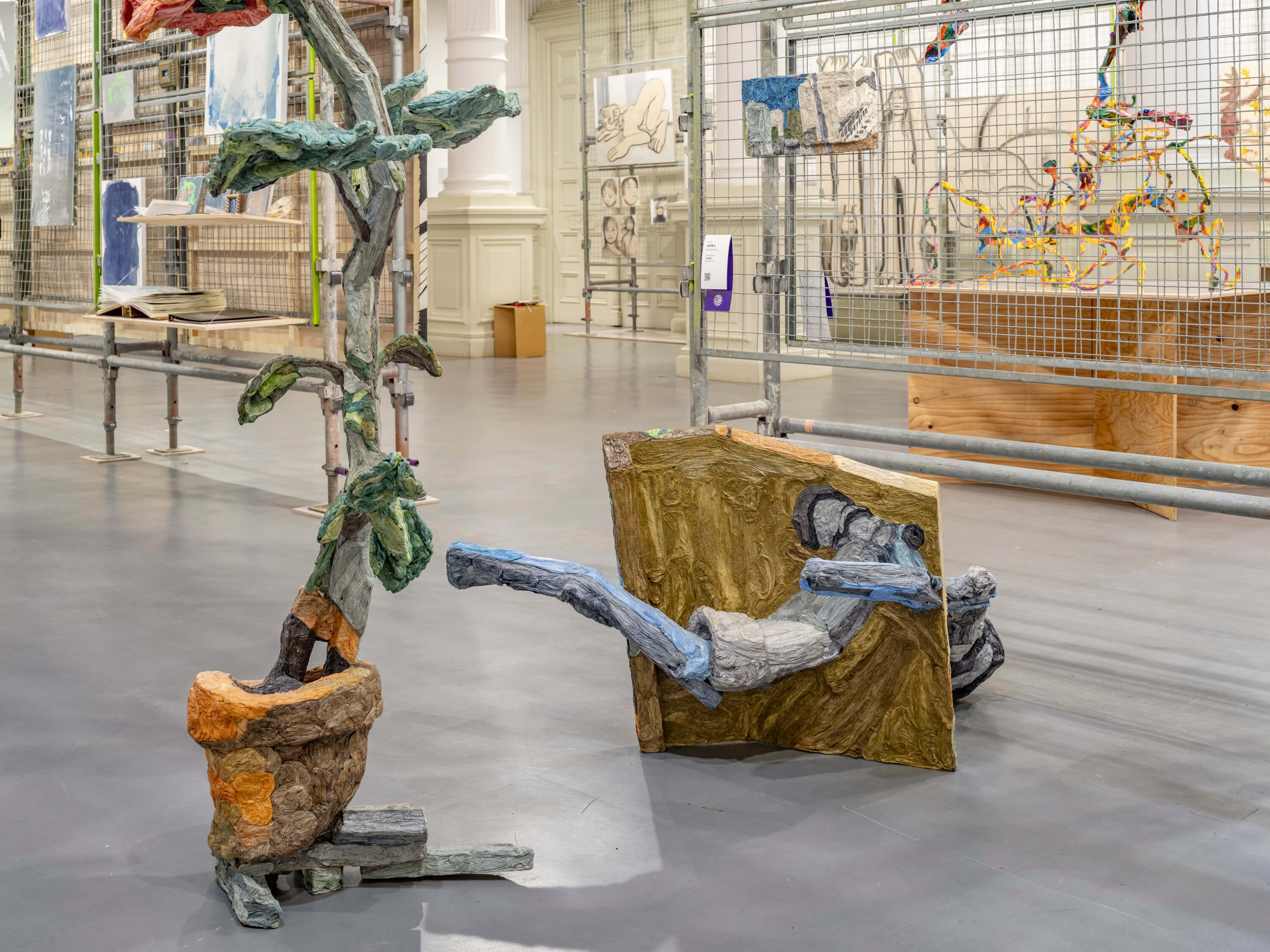
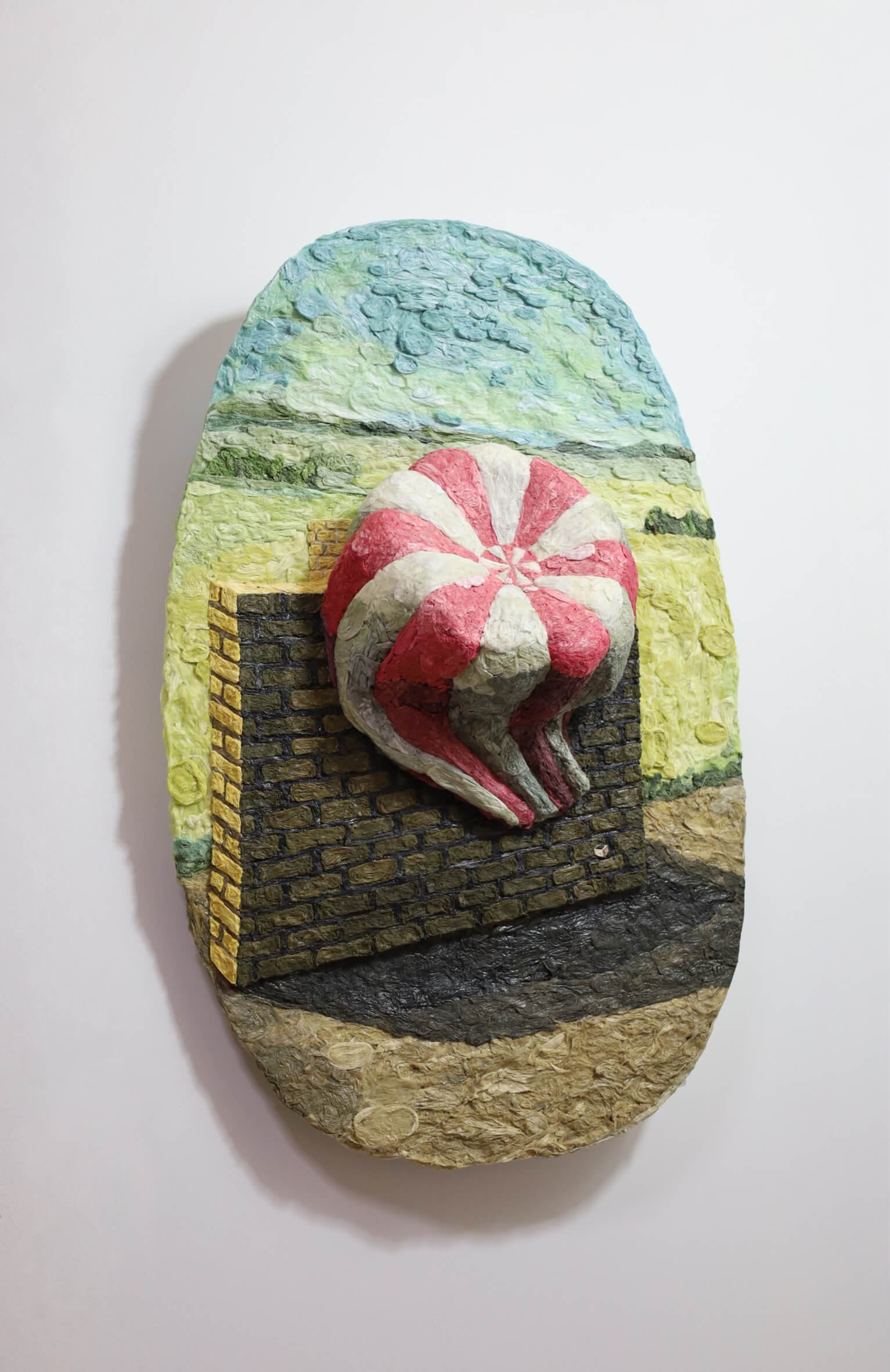
Wankyoku Hariko is a technique in which paper is applied to a mold, the resulting painted membrane is peeled away, and then attached to a support. In that sense, it is a sculptural method that is closely related to the act of drawing or painting, rather than to conventional sculpture. Through Wankyoku Hariko, I was able to overcome my own inability to make sculpture at that time.
—What perspectives do you value in your creative process, and what do you consciously keep in mind when you work?
There are stages in the creative process where objective judgment is no longer sufficient. For example, when selecting materials or deciding on the scale of a work, it is possible to make decisions from a detached, objective standpoint. However, at moments such as envisioning the overall form of a piece, or when the sculptural form takes shape and its actual structure is determined, objective judgment alone can sometimes feel inadequate.
In those situations, I place importance on not being afraid of subjective and unknown decisions. In my own practice, once my thinking becomes too clearly organized, the work tends to lose its sense of newness. Subjective and unfamiliar judgments can, at times, carry a certain universality, and it is surprisingly important to accept the forms and situations that emerge as a result of such decisions.

—With three-dimensional works, the viewer’s impression can change greatly depending on how they approach the piece. How do you think about the distance between the work and the viewer, or the viewing path?
I use different approaches to distance and lines of sight when making a work and when exhibiting it.
When I am creating a piece, my own body serves as a primary point of reference. For example, I begin from a position where the entire work fits within my field of vision—where straight lines actually appear straight—and then consider how the work changes, or does not change, as I move slightly closer or shift sideways. These bodily movements are deeply involved in the process of making the work.
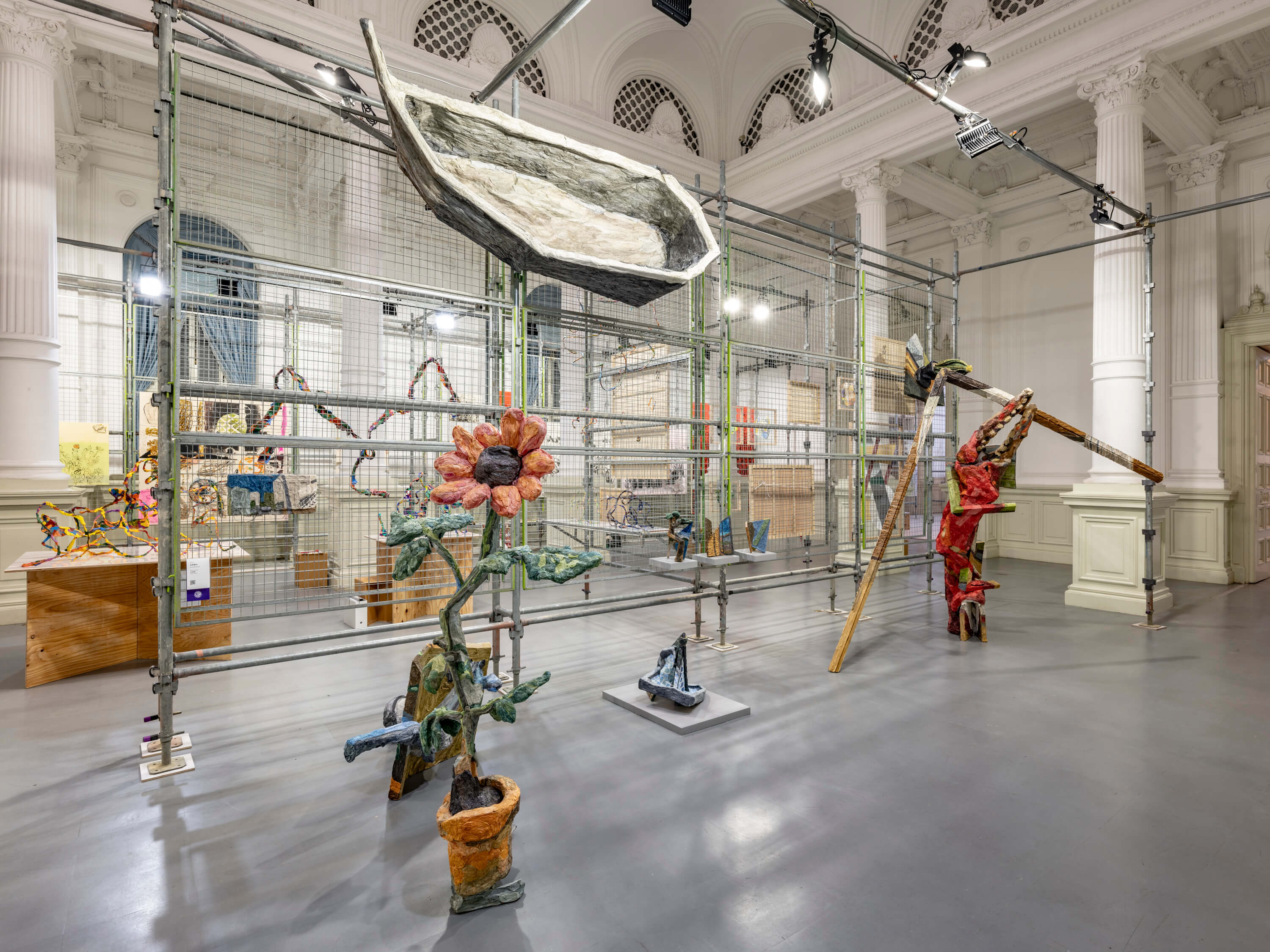
When it comes to exhibition, however, the point where the viewer first encounters the work often becomes the main reference. I see this as a dialogue with the architecture in which the piece is placed. During the time spent viewing, exploring and discovering where the work connects with the architecture and where it separates from it is very similar, in terms of awareness, to the act of attaching paper in my sculptural process.
—You received the Grand Prize of the MyNavi ART AWARD at ARTISTS’ FAIR KYOTO 2025. How did this award bring about changes in your practice or broaden your perspective as an artist?
Receiving the award gave me an opportunity to reconsider my practice from a broader perspective. Regardless of how the exhibition itself turned out, being able to present and have evaluated the body of work I had produced over the five years since 2020—before a large audience and in a place outside the Kanto region, where I had previously been active—was a very meaningful experience.
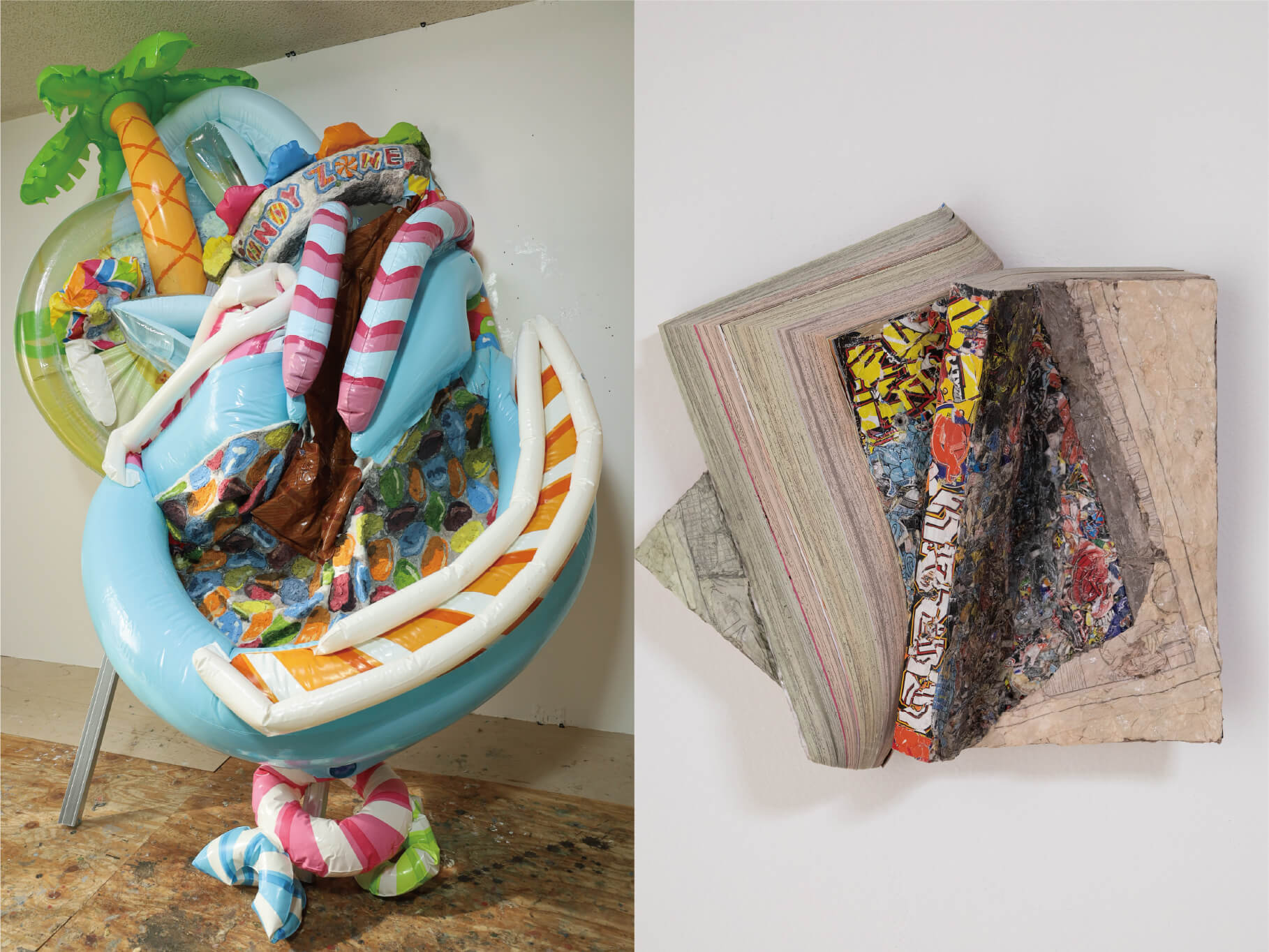
Perhaps influenced by this, my practice changed significantly in 2025. Until then, I had worked exclusively with dyed paper as my primary material, positioning the structures of painting and sculpture in opposition within my own thinking. More recently, however, I have begun focusing on images found in mass-produced objects such as comics and inflatable vinyl pools, and my work has come to adopt a more literal and shareable approach to relationships such as painting and sculpture, or form and representation. The body of work centered on Wankyoku Hariko has started to bear fruit for me, allowing new developments and expansions to emerge.
—You are scheduled to hold a solo exhibition at Tofuku-ji Temple, the head temple of the Rinzai school of Zen Buddhism, in 2026. Has exhibiting in such a historically significant space influenced your practice?
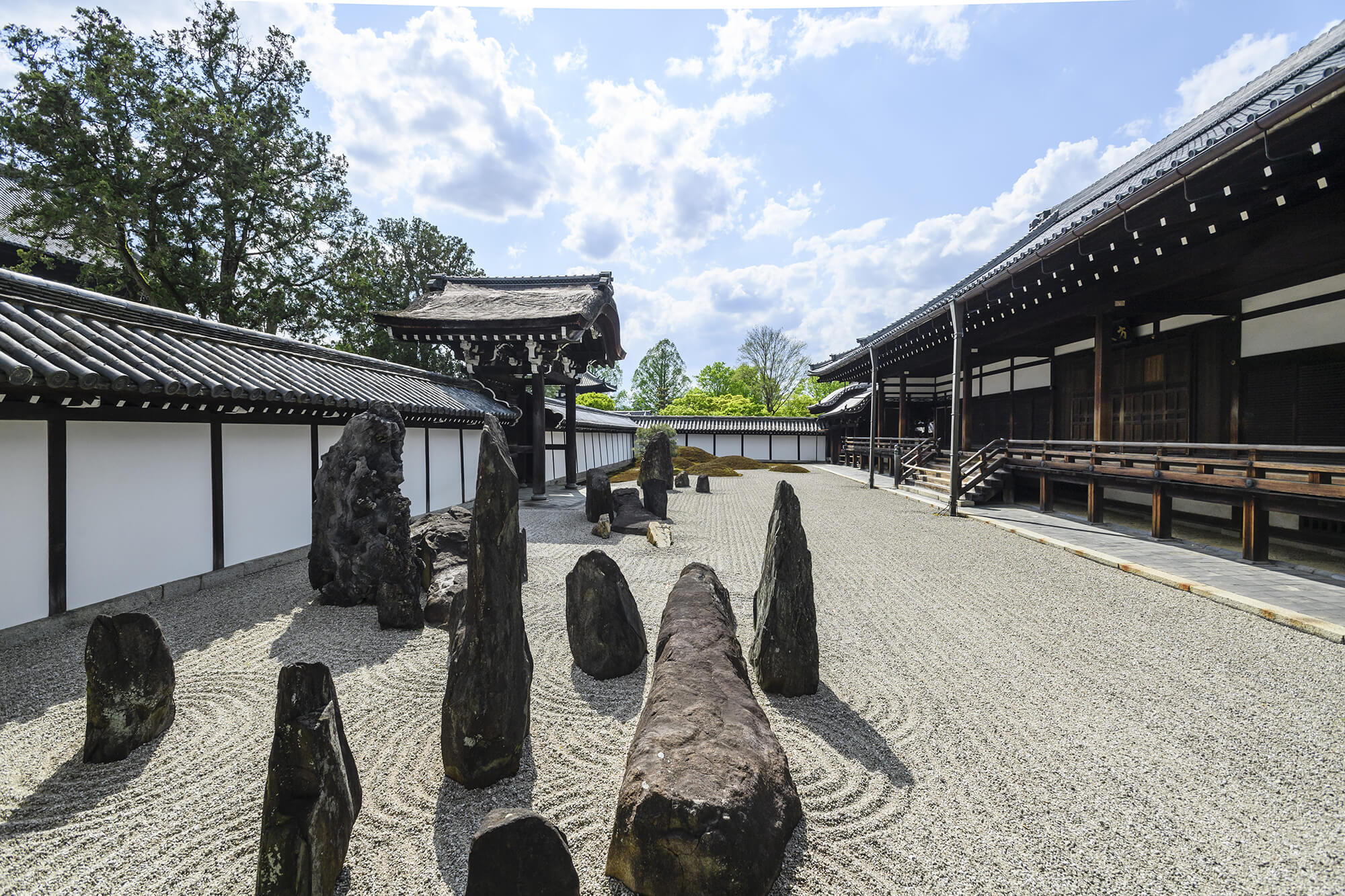
At this point, I am consciously thinking about maintaining a relationship in which the works do not merge with the exhibition space, and in that sense the space has already had an influence on my practice. Through several site visits so far, I have felt that the temple is a place that powerfully evokes bodily sensation. The way sunlight enters the rooms, how it is reflected or absorbed, how it flows between the pillars and moves back and forth toward the mountains outside—these experiences make it feel as though a kind of microcosm has been expanded within the architectural space, governed by dynamics unique to this site. There is also a distinct architectural unit imbued with the sense of decorum characteristic of religious architecture.
When I encounter materials and forms in the sculptures I am currently working on that might both oppose and enter into dialogue with the temple’s sensory effects and its social presence, I find myself experiencing a sense of surprise that could not have arisen from my practice alone. For the exhibition, I am considering whether emphasizing the contours of the sculptures might allow them to establish a more equal relationship with the site.
—Your connection with Kyoto seems to be deepening from this year into next. What kind of place do you think Kyoto will become for you?
Kyoto has a powerful cultural foundation—its significant gardens, classical art, and cuisine that is both refined and deeply evocative—and there are times when exhibiting my work there feels almost overwhelming. Even so, there are many people who engage with my work directly and earnestly, which allows me to take risks in my practice with a sense of reassurance.
Gardens, classical art, and Kyoto cuisine are not unrelated to sculpture or contemporary art; I can feel both formal connections and a sense of productive tension with them. Having a place where I can challenge myself and be rigorously evaluated is extremely valuable to me at this moment. I hope to continue approaching each opportunity with full commitment so that these connections can keep growing.
—Are there any new fields of expression or challenges you would like to pursue going forward?
Recently, I have been thinking about a sculptural approach I call “indirect expression.” In my work so far, I have incorporated painterly elements into sculpture, giving sculpture a way of being viewed as representation. As a result, sculpture has not been confined to a direct grasp of form; instead, a condition has emerged in which representational ways of seeing and formal ways of seeing pull against each other.
I think of placing the greatest emphasis on this tension within a work as “indirect expression.” This idea is not limited to the relationship between representation and form alone; it can be applied to various kinds of relationships and across different artistic fields. For now, I want to focus on producing tangible results from this approach.
I am also interested in identifying other artists who work through forms of “indirect expression,” organizing exhibitions together, and exploring where this way of thinking might be situated within art history.
Keita Motooka
Sculptor
Born in Hiroshima Prefecture in 1999. Motooka completed a master’s degree in Sculpture at the Graduate School of Fine Arts, Tokyo University of the Arts, in 2024, and is currently enrolled in the doctoral program in the same field. He creates sculptural works using a process of attaching dyed paper, producing works that exist in an intermediate space between sculpture and painting, through which he explores the possibilities of artistic expression.

Links
Instagram:https://www.instagram.com/motonini3768/
X:https://x.com/KeitaMotooka
Event Information
Keita Motooka Solo Exhibition
IMMANENT FOLD: Immanent Folds of Image and Material
Dates: February 20 (Fri) – March 1 (Sun), 2026
URL: https://artists-fair.kyoto/events/
Concurrent Events:
ARTISTS’ FAIR KYOTO 2026
Main Venue
Dates: February 21 (Sat) – February 23 (Mon, public holiday), 2026
AFK Resonance Exhibition Venue
Dates: February 21 (Sat) – March 1 (Sun), 2026
URL: https://artists-fair.kyoto/
Edited by: AWRD Editorial Team